Golf, Shane Lowry, US Open 2017

US Open 2017 – Preview

The US Masters may have finally seen Sergio Garcia free himself of golf’s least wanted moniker – apart from worst player in golf- but the year to date has been largely uninspiring. This is what happens when Rory McIlroy, the unquestioned star draw of golf in 2017, is absent from competition. There are of course other star performers on the tour but McIlroy is the one of the few of the new breed with a personality and, like him or not, he does generate column inches.

Tiger’s gradual demise and likely realisation that further professional competition is now forever out of reach for the GOAT has cast a slightly forlorn light on proceedings of late. Still, the show must go on and today sees the players line up for the year’s second major, the US Open Championship.

Erin Hills, Wisconsin plays host to its first ever major championship and with the pre-tournament talk that Erin Hills shares similarities with the Daliesque Chambers Bay, at least in appearance, we’re extremely excited for what the weekend holds in store. The PGA Tour have gone to great lengths to quell any fears over the quality of the greens – Chambers Bay surfaces were just a little quirky – so, at least there should be less whinging from disgruntled players.

Holy Hill

The basilica on ‘Holy Hill’ adds to the unique setting of Erin Hills

At first, the course sounds like a misnomer as Wisconsin is Irish-midlands flat. But, due to the remarkable effects of glacial erosion, the course presents as “a links course on steroids” according to popular pre-tournament tip, Jon Rahm.

We took a slight sabbatical from writing and gambling, mainly due to the lack of money in both, but there’s nothing like a wide open field with an abundance of seemingly sound betting tips to get the juices flowing again. As usual, we’ll have a quick run through the favourites and then on to our value bets, which shall be conspicuous this week for the absence of future major champion, Brooks Koepka. On the basis of how effortlessly we make a fool of ourselves, Koepka will now in all likelihood win.

Favourites

It’s nigh on impossible to defend this title and at odds of 7/1, we’ll  be avoiding Dustin Johnson. Also, despite his maiden major victory in 2016, we still have visions of DJ’s meltdown in Chambers Bay dancing in our head.

Jordan Spieth 12/1 certainly showed the mettle to capitalise on Johnson’s slip-up two years ago but the Texan was in the midst of an incredible, perhaps once-in-a-career, run of form. We’re still not sure if he’s banished the ghosts of Augusta 2016 and even with a new, hot putter in hand, we’ll avoid.

Rory McIlroy at 12/1 has to be avoided due to his prolonged absence and uncertainty, at least from an outsider’s perspective, as to how he’ll fare on his return from a lengthier than expected injury-enforced hiatus. After his comments this week, he’ll want to avoid missing the now gigantic fairways.

Which leads us to Jason Day (16/1), the man who would be king at the end of 2015. A propensity for migraines and assorted ailments conspired to derail his game somewhat, at least from its imperious best, in the latter part of 2016. However, when his mother was diagnosed with advanced lung cancer in early 2017, the Australian’s attention was quite naturally averted from the relatively minor distraction of the golf course.

Thankfully, the Queenslander’s mother, ‘Dening’ underwent successful surgery in March and with the important things in order in his life, Day has found form of late once more with finishes of 2nd and T15 at the Byron Nelson and Memorial respectively.

When he’s on it Day can grind with the best of them and while his general stats are down on previous years, these can be ignored given the year he’s had. He hits it long which is a must on the massive, 7,700 yard Erin Hills.

Obviously, given the small sample size of form there are risks involved but with question marks surrounding all the favourites an unusually big 16/1 on the Australian is difficult to ignore.

J Day

J Day has had a tough year but has returned to form in recent weeks. Our pick of the favourites.

And now on to our selections. While Thursday’s dreams are usually left lying in the gutter before the weekend is out, we’re feeling confident after our lengthy hiatus.

Before you continue with these aimless ramblings, it might be worth reading this excellent, reason-based preview from Betfair.

First, to our honourable mentions.

We’ll be avoiding Spanish wunderkind, Jon Rahm (20/1) but there is a lot of love for him at the moment. His form in the majors is a concern and it’s hard to tell how he might cope down the back nine on Sunday evening. Still, it’s been a great year for the Spanish and there will be plenty of people willing to ignore his lack of experience on this stage.

Branden Grace (40/1)  is a long-standing favourite around these parts and has very impressive major form, including his top 5 at Chambers Bay. Concerns remain over his form this year, however.

Justin Rose (22/1)  appears to only coming round from his Masters defeat at the hands of Garcia. Only those who have been defeated in such a fashion know of the mental toll imparted. Winner at Merrion in 2013, Rose has always struck us as a resilient soul but we get the feeling this one may have come too soon.

Before we move on to our selections it’s worth noting that five of the last six winners of the US Open have been in the top 15 of the Official World Golf Rankings at the time of the victory. None of our picks are currently placed higher than twentieth. To the foolhardy and the dreamers, do read on……

US Open 2017 Tips

  1. Kevin Kisner (50/1)

Kisner is flying at the moment, following up his victory at the De Luca Invitational with a 6th at the Memorial. The South Carolina native goes about his business quietly and is largely indistinguishable from the cache of promising thirty-somethings on the PGA Tour. Still, he is very much on an upward curve and his upper mid-table stats in every department mean he’s just the type to hang tough on a course that will play long but also very soft.
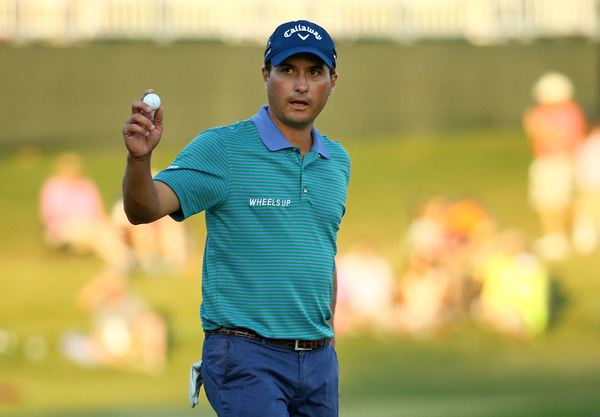
THE PLAYERS Championship - Final Round

The extremely understated Kevin Kisner has been a very popular tip for success this week.

 2. Louis Oosthuizen (50/1)

We had high hopes going into the Masters that Oosthuizen could deliver going in under radar, as the highly-talented South Africans generally and rather oddly do prior to major tournaments.

Oosthuizen, winner of the 2010 Open Championship, has a fine record in majors and narrowly missed out in Chambers Bay, where he came home like a train. He obviously handles links-type courses well and his pedigree in big tournaments speaks for itself. Also, and perhaps most importantly, Oosthuizen’s ability to scramble means he’s ideally suited to Erin Hills layout.

  1. Shane Lowry (55/1)

Lowry has now officially undergone that difficult Sunday afternoon – a seeming rite of passage for future major winners – after leading into Sunday in last year’s US Open before faltering on the back nine. Traditionally Lowry is streaky and he’s found form again of late and tallied with his top 10 in Chambers Bay, he may not be a bad shout at 66/1. It really comes down to his temperament though and whether last year’s experience will rattle him – think pre-2017 Sergio – or imbue him with the confidence to handle the pressure appropriately.

  1. Matthew Fitzpatrick to finish in Top 10 (11/1)

This hugely talented young Englishman has been tentatively tipped by some to make a major move this week in Wisconsin. Fitzpatrick, a recent winner at the Nordea Masters has recorded the most top ten finishes on the European Tour this season. Driving distance, at a tick over 280 yards, is definitely a concern but his results have been outstanding in recent months and a top 10 finish is comfortably within the twenty-two year olds reach.

While he may rank the lowest (No.69) by a comfortable margin in the OWGR, we’ve got a feeling Shane Lowry is going to very close this weekend. As mentioned earlier, the Offaly-man has a habit of hitting form for a few weeks at a time, slowly building and then delivering an outstanding performance. The past few weeks have shown a marked improvement and Erin Hills should be to his liking.

Offaly GAA Announce The Faithful Fields, Centre of Excellence Plans

With their hurlers set for a rough afternoon with Galway, Shane Lowry can give the Offaly faithful something to cheer about on Sunday evening.

It was only two years ago that Lowry broke the world’s top 20 and he is a player of immense talent, but one that really needs to be switched on. The predicted inclement weather will pose few problems and if Lowry has the mental side of his game in order, then he should be able to plot his way around the geological oddity that is Erin Hills. Should he keep his composure then Offaly sport might just have their greatest Sunday since they came in the back door in 1998.

S.U.S. Predictions

  1. Kevin Kisner @ 50/1
  2. Louis Oosthuizen @ 50/1
  3. Shane Lowry @ 60/1
  4. Matthew Fitzpatrick (Top 10) @ 11/1
Standard
Rugby, Rugby Union, Six Nations 2017

Madness in the Method?

The last 12 months have entailed both the very best and most frustrating aspects of this current Irish rugby team. So close in South Africa, then exceptional in Chicago. Gutsy against Australia, caught cold in Edinburgh, followed by sleeves rolled up efficiency and toughness against France. Then a return to old failings in Cardiff last weekend. After a truly mixed season, Ireland return to the place where they so often thrive, backs to the wall and with little expectation.

If the plethora of ‘ifs’ had gone our way in the past six weeks alone, the last few days would have been filled with the fever pitch that only accompanies a Grand Slam showdown. Instead and after a listless opening forty in Edinburgh and, as with 24 months ago, a performance in Cardiff where plan B was clearly left at home, Ireland face England with no tangible wares on the line. They do, however, have an opportunity to measure themselves against the world’s second best side and prevent two records falling. England, meanwhile, have the chance to record the first back-to-back Grand Slams in Six Nations history and break the record of eighteen straight victories held, of course, by themselves and New Zealand. There is no question as to whose winning streak is more impressive but should England prevail on Saturday the history books won’t lie.

The question for Ireland, after the harsh reality of our inability to break down defences without going through multi-phases, is whether we can live with a side who are now marrying potent offence with the discipline which Eddie Jones immediately instilled on his arrival in 2016. The rather frustrating and none too illuminating answer is that, yes, on one off occasions we can live with any side in the world. Therefore, if Ireland win on Saturday where does it leave them, apart from the obvious position of a fairly distant second behind England and marginal leader of the chasing pack.

If you examine the 11 game run which begun last June at the foot of Table Mountain and led into last Friday night’s all too familiar defeat in Wales it’s clear that Ireland are a good side that can deviate from brilliant to decidedly blow average. Nothing revelatory there. However, perhaps of more relevance is the fact that Ireland succeed when their set-piece performs to a markedly superior level to that of their opposition. New Zealand and Australia struggled mightily against the Irish scrum, while the line-out provided a match-winning platform in Chicago. Disrupt Ireland here and it would appear that they are bereft of ideas.

The Irish management team are growing increasingly prickly towards journalists who ask whether Ireland have become either too predictable or are lacking in offensive thrust. Scratch too close to the bone and people generally become uncomfortable. To an untrained eye, last Friday’s attack seemed to revolve around flat one or maybe two out runners and a brand new trick….. the wraparound. The latter generally led to an isolated Keith Earls or Simon Zebo kicking ahead into space and chasing. From such great coaching minds, it hardly smacks of ingenuity.

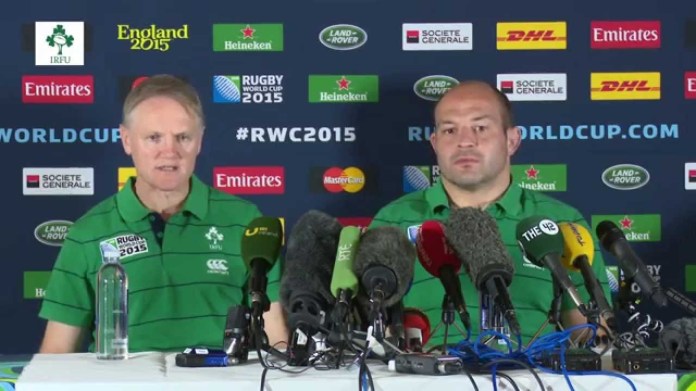
Presser

Irish rugby journalists have committed the cardinal sin of both doing their job and asking relevant questions at recent press conferences. 

Barring the ten-try evisceration of the then 14th ranked team in the world in Rome, Ireland’s attack has struggled mightily throughout this tournament. Scotland’s defence can be charitably described as average, while to be fair the French encounter was never going to yield a great attacking dividend given the conditions. Wales, in Cardiff however provided a perfect marker as to the progress Ireland have made offensively since the uncannily similar defeat in 2015. The answer, it would seem, is very little.

Despite his excellent performance in Cardiff, for the sixty minutes Johnny Sexton played last weekend Ireland struggled to create any real opportunities, the two best breaks of the game coming from Donnacha Ryan and CJ Stander. For all of Robbie Henshaw’s strengths he is not, at least yet, a midfield creator in the mould of Jeremy Guscott or Tim Horan. Of course, he is still an outstanding defender and carrier and there is the hope that his game can develop along a similar line to that of Ma’a Nonu. However, in the short term Ireland need something beyond Sexton’s often isolated efforts, so Jared Payne’s inclusion should at least offer the option of a playmaker from the back.

England, more as a result of serendipity than design, have happened upon an outstanding 10-12 axis, with Owen Farrell operating as a first five-eighth outside George Ford. Both are excellent distributors, Ford is a genuine running threat and Farrell complements these skills with huge, often times punishing defence. Ireland won’t be fooled into thinking they’re running at a converted out half in Farrell meaning Ford’s rush defence, highlighted by Gordon D’Arcy in this week’s Irish Times, needs to be exploited somehow.


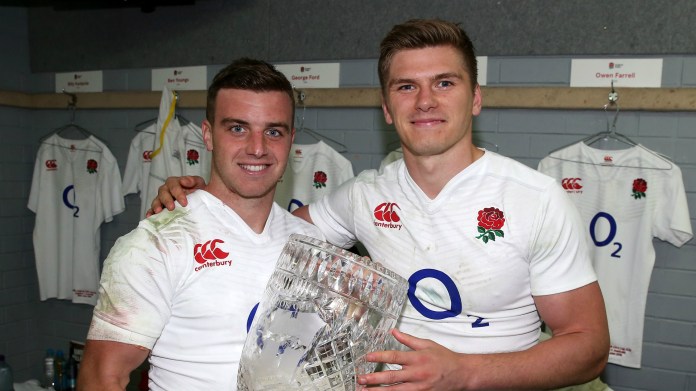
F & F

England have fortuitously arrived upon a hugely successful midfield pairing in old friends George Ford (l) and Owen Farrell.

There has been much talk of Ireland’s structured system which is possibly predicated on the fact that carefully managed phase play eventually leads to gaps appearing, somewhat akin to chess. The problem with this kind of rugby is that it grows stale in a hurry when it becomes ineffective. For all the pressure imposed by Ireland last week, and the herculean Welsh defensive performance should not be taken for granted, the closest the visitors came to scoring was from a rolling maul.

Owning the ball in rugby doesn’t quite equate to soccer, where the objective is to press and probe until an opening appears. If rugby, as structured phases amass, the defensive line become more comfortable with their assignment. Maybe Ireland have a rabbit in the hat for Saturday’s encounter but the one time they tried a semi-coherent move off an attacking scrum last week Keith Earls spilled it, perhaps mindful of the fact that the Welsh midfield had telegraphed the move from the off.

Further, and as has been the case throughout this year’s Six Nations there is the issue of Ireland’s back row. From the limited sample size on offer, it appears that the combination of CJ Stander, Sean O’ Brien and Jamie Heaslip is actually less than the sum of its parts. The problem of course is that Stander was the best of the trio last week, Heaslip appears to be nigh on undroppable and with Josh van Der Flier out, there is a lack of experienced depth on the open side. There is a persuasive argument for Peter O’ Mahony’s inclusion but at whose expense? Schmidt is, not unreasonably, keeping the incumbent combination together for the tournament finale but if they are unsuccessful in stymying England, no small achievement, then others – O’ Mahony, Dan Leavy, Jack Conan- will have to be considered going forward.


Ireland-Backrow

The Six Nations have thrown up a mixed bag for the Irish back row so far. A big performance on Saturday would offer huge respite.

Ireland have become all too familiar with life without Johhny Sexton in the past eighteen months and now, with a juggernaut coming to town, they must contend with the absence of their other backline lynchpin, Conor Murray. Kieran Marmion will surely relish his opportunity and given his presence and the inclusion of Payne Ireland will probably attack with greater tempo and, dare we dream, invention.

The coaching team have spoken this week of the need to be clinical in opposition territory. England appear to be a performance ahead, at least, in this regard after last week’s demolition of Scotland. Ireland won’t wilt like the disappointing Scots did but nothing thus far in this year’s tournament suggests they’ll be able to repel and breakdown a flourishing English side, buoyed further by Billy Vunipola’s return to the starting line-up. The visitors are on a discernible upward curve while Ireland, ironically given the methodical nature of their play, remain difficult to read.

The frustrating, or perhaps brilliant aspect of this Irish side, is that they remain capable of beating anybody when their up-tempo pace complements a dominant set-piece. England, though, will be primed for an emotional performance from the home side, particularly after being stung in 2001 and 2011 when hunting Grand Slams. Outside of England it’s unlikely that anyone wants Eddie Jones to succeed where all others have failed before him. But in a week where Queen Elizabeth II gave the royal nod for Brexit talks to commence, it seems likely that England will successfully impose their superiority in a more anodyne, sporting manner.

Straight Up Sport Prediction: England by 4

Tips: (i) Handicap Draw (Ireland -4) @22/1

           (ii) Under 37.5 points @ 6/5

Standard
Rugby, Rugby Union, Six Nations 2017

French test a defining moment

After the defeat in Edinburgh, the perception seemed to go from glass full to glass half-empty with little consideration for rationale or perspective. Now, after the massacre of a poor Italian side in Rome, the mood is tentatively lifting once more. It defies explanation but Irish sides always seem to perform better when there is a pervading sense of uncertainty or even borderline negativity in the air. New Zealand in 2013 and again last November and South Africa last summer are obvious recent examples.

There’s no question that the Irish squad would have applied themselves as professionally as ever to training and video sessions in the lead up to round one of this year’s Six Nations, but you have to imagine that they are not impervious to the prevailing view of the media and the general public. Not that they necessarily believe what’s being said in the lead up to games but it must seep into their psyche. Alternatively, one could take the view that the Irish rugby public place unduly lofty expectations to their national side. That’s probably an argument for another day but, for now, this Irish side finds itself in a seemingly more palatable position, surrounded by tentative expectation. That said, the internal pressure to perform is, no doubt, as high as ever.

The fixture list has been kind to Ireland.  Though downed by the Scots, they were immediately offered a regeneration programme in Rome, safe in the knowledge that victory was nigh on certain. France have always given Ireland difficulty, even during their recent phase of rudderless management and feckless, downright incomprehensible performances. Now, Guy Noves side are resurgent, considering where they were coming from, and they’ll arrive buoyed by a fine performance in Twickenham and a hard-fought and welcome victory over Scotland in Paris.

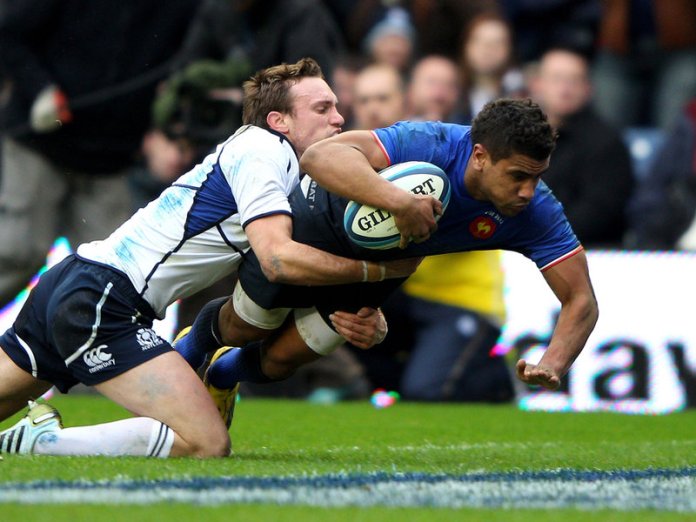
france-v-scotland

France were far from perfect in beating Scotland but they travel to a stadium that holds no fear for them.

Throughout the fist decade of this century, Noves led perhaps the greatest club side ever, in four time Heineken Cup winners, Toulouse. While we remember the individual artistry of Clerc, Poitrenaud, N’Tamack and Jauzion, the success was built on the dominance of the Fabien Pelous-led, gargantuan pack. That team was a joy to watch, and unlike the rubbish in the Top 14 nowadays, they realised that powerful forward play can be married to scintillating incisions from the backline. While Noves’s legacy with Toulouse is redoubtable, Shane Horgan made the point recently on Second Captains that Toulouse’s heydey was more than a decade ago. Rugby has changed considerably since then and it seems that Noves’ greatest strength at this point is his ability to galvanise a French collective who seemed to have lost their way.

As we’re all taking advantage of the residency rule, it would seem trite to criticise the French for selecting a southern hemisphere-flavoured back field but they have done well to hand pick Noa Nakatici, Viremi Vakatawa and Scott Spedding. Vakatawa misses out tomorrow and is replaced by another powerful unit in Yoann Huget. As is often the case with bulldozing wingers, accepted wisdom is that opposing teams need to turn them around and take advantage of their relatively poor field positioning in defence. Ireland’s go-to box-kick game will likely be refined somewhat to include the lesser-spotted line drive into opposition territory. Nakatici doesn’t offer a huge amount in defence but then neither did Vincent Clerc and he still seemed to do ok against Ireland.

Though it’s a position rich in depth, it would be difficult to argue against Louis Picamoles being the tournament’s foremost number-eight, particularly given his recent return to the form of 2014/15. His performance in Twickenham was exceptional and he is possessed of the greatest attacking brain of any forward in the tournament. Ireland’s back-row struggled mightily in Scotland then lorded it in Rome, aided by the hopefully, temporary diminution of Sergio Parisse’s powers, but the upcoming tests will prove an accurate measure of the balance of the current Irish unit.

Whatever the prevailing view at the moment, Saturday’s performance should go a long way towards confirming whether the Stander, O’ Brien, Heaslip combo can perform effectively in all facets of the game. Stander and O’ Brien in particular need to have a plan B in tow for when the wrecking-ball approach is nullified, while all three need to establish parity on the ground, at the very least. Ireland’s back row options are healthier now than ever before and the current trio will be mindful of this.

cj

A strong performance from CJ Stander should cement his place in the Irish back row.

To injury news, where the Irish Rugby fake news department was at it again this past fortnight. It’s not exactly groundbreaking stuff given the age-old propensity of hurling and Gaelic football managers to insert A.N. Other at corner forward but Schmidt’s Ireland appears to be less than forthcoming with their injury reports. Donnacha Ryan appeared to be fit for the Scottish game while the public was initially informed, with little purpose, that injury kept Ultan Dillane out of the trip to Rome. If nothing else, it’s slightly bemusing but perhaps the Irish management team feel they can gain advantage from concealing this information for as long as is possible. And, on that note, Rob Kearney returns from a seemingly championship–ending injury with Andrew Trimble replacing what must be the most deflated hat-trick scorer ever in Craig Gilroy. As has now become custom, Tiernan O’ Halloran is left to mull over just what it is he needs to do before Schmidt will notice him.

Paddy Jackson deputised more than adequately these past few weeks but, for the time being, there is still little argument over the first-choice Irish out-half. If Sexton stays standing on Saturday then this will all blow over, and one hopes the incumbent number ten is merely going through a rare and unfortunate run of injuries. While the coaching staff were glowing in their praise of Jackson this past week, it’s clear how highly they value Sexton’s leadership and ability to raise the game of those around him. Further, on a more visible level Sexton is near peerless at carrying the ball to the line, an aspect of his game that Ireland missed so dearly in Edinburgh.

sexton

Unsurprisingly, Johnny Sexton and his fitness have been the main topics of conversation in the lead up to this fixture.

For all the major advancements and scalps of the last few months there are still considerable question marks over Ireland’s defence. While they performed admirably in South Africa, bar the second test where altitude had its say, Ireland have been relatively porous since. With the exception of the facile Italian victory, Andy Farrell’s unit have conceded at least three tries in each of the past five games. And this despite Ireland controlling the majority of possession in each contest. A narrow line and lack of line speed are oft criticised but there have also been a number of missed one-on-one tackles. Whatever the ailment and more importantly the cure, Ireland could make life a lot easier for themselves if they didn’t require, on average, twenty-five points to win each of these contests. The caveat, of course, is that this is a small sample size. England, by comparison, may not sparkle but their defence has been mostly rock solid under Eddie Jones, although admittedly the latter have judiciously or perhaps fortuitously avoided New Zealand throughout their unbeaten run.

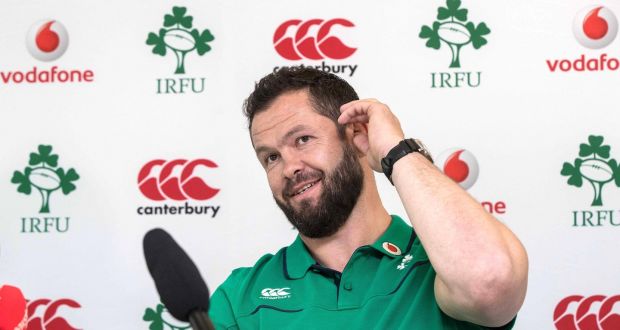
andy-farrell

Ireland’s defence is yet to click under the guidance of former, dual-international, Andy Farrell.

France will run hard as ever and will jump at the opportunity to move the ball wide while their counter-attacking game has been resuscitated as evidenced by some fantastic deep bursts in Twickenham. Ireland too evidenced their ability to return the ball dangerously from deep in Rome and this must continue into the encounter with France. There is no questioning Rob Kearney’s excellence under the high ball but with O’ Halloran and Simon Zebo breathing down his neck, he needs to show his the consistent ability to link effectively with his wings.

The reality is that Ireland need to win all the way home and see whether Scotland can create some problems for the English in a fortnight’s time. Talk of bonus points seems ludicrous given the defensive qualities of Ireland’s remaining opponents. If the back row click, Sexton hits the ground running, which to be fair he always does after injury absences, and Conor Murray completely sheds the last vestiges of his mini-slump then Ireland will win. But any idea of a runaway victory is fanciful.

It’s clear that Ireland are probably somewhere between the majesty of Chicago and the fitful, frustrating performance in Murrayfield. If they defend as in the latter match, then France will have a comfortable, early spring evening. That outcome seems most unlikely though and Joe Schmidt and, more pertinently his side will be aching to rise to the pitch of November once more.

Ireland see themselves as the most obvious challengers to England’s dominance in the north yet victories are the only way to further this claim and usurp the latter. An improving France will provide a stern mid-tournament examination of Ireland. Expect the home side to respond accordingly.

Straight Up Sport Prediction: Ireland by 6 (Odds Ireland -8)

Tips: (i) France +8 @10/11

           (ii) Simon Zebo anytime try scorer @ 2/1

           (iii) Johnny Sexton first try scorer @ 25/1

Standard
Irish Rugby, Six Nations, Six Nations 2017

Don’t Mention the Bus

Irish supporters and media have spent the days since Saturday dissecting a seemingly terrible performance. The Scottish public, meanwhile, has no doubt been basking in the warm glow of what they view to be a wonderful display. The truth, however, or at least the true quality of each side’s performances probably lies somewhere in the middle.

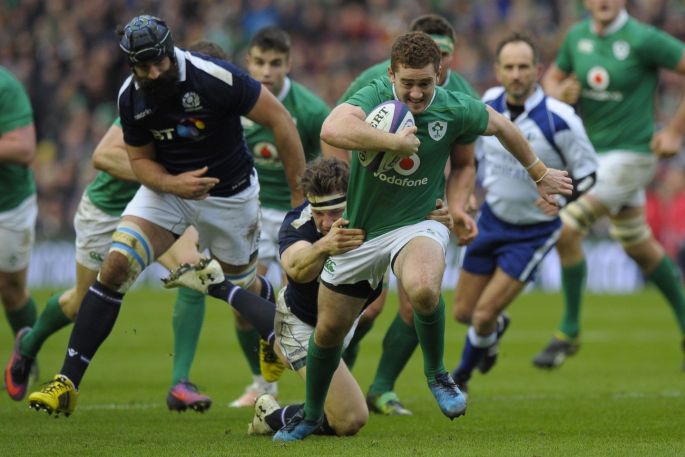
Scotland, on the one hand, commendably identified that old Irish bugbear – soft, narrow defence –  and punished it. Throw in a pretty clever, one-off lineout play and a quietening of a seemingly unstoppable Irish back row, in a manner not seen since Wellington 2011, and it’s fair to say the home side got a lot right.

Still, Ireland dominated the scrum, in addition to possession, and by sixty minutes had fought their way into a position of dominance reflected by their perilous one point lead. Ultimately, the combination of heavy legs, a weak bench and a lack of accuracy – no doubt brought about by that insurmountable challenge of the fifteen-minute bus delay – meant that Scotland actually closed out the game with relative ease.

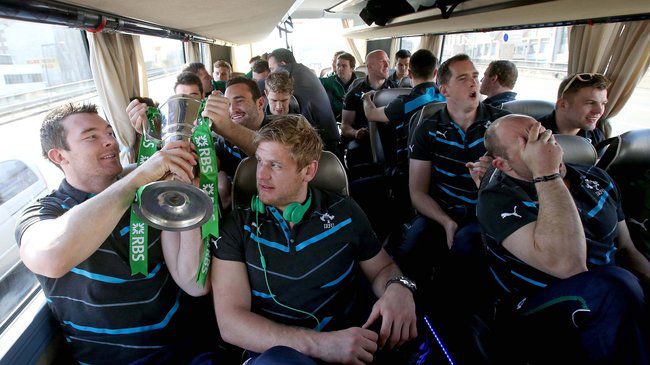
Peter O'Mahony and Chris Henry pass the Trophy around the bus 16/3/2014

The Irish team bus in happier times.

In any event, the game has been dissected ad infinitum and, as has been the case since the beginning of time, media and supporters have moved seamlessly from discussing the Grand Slam showdown with England to questioning how we’ve fallen so far, so quickly.

Now, of course, by losing their opener Ireland will in the words of Aaron Rodgers, ‘have to run the table’ in order to be victorious in March. However, the defeat has also focused minds and will, if nothing else, bring an end to our unnecessarily lofty expectations. And, the Grand Slam should not be the measure of a season, winning the championship should.

In that sense, the visit to Rome on Saturday offers the best tonic. France have affirmed their November regeneration and look lively again, Wales robust and business-like. Under no circumstances would Ireland be best served by appearing under the Friday-night lights in Cardiff after last week’s performance. Some might argue that a stiff challenge would force Ireland to step up immediately but back-to-back defeats could force Ireland into a tailspin. Therefore, with all due obligatory respect to the Italians, a victory in Rome will at least allow Ireland to keep their season alive. How they go about achieving that result will be of far more importance.

Cian Healy comes in off the pine, while Donnacha Ryan, back from a knee strain and playing out of skin this season comes straight into the starting line-up, with Iain Henderson getting an unexpected weekend off. As well as Scotland competed last weekend, Ryan’s raw edge and experience were sorely missed both in the lineout and at close combat. Healy, meanwhile, has a chance to stake a claim for a jersey once permanently his but surely, all eyes will turn to Ireland’s back row, one that may be struggling for balance.

d-ryan

The returning Donnacha Ryan should boost the Irish line-out, which was dominated in Murrayfield.

Scotland cleaned Ireland out on the ground last weekend, aided by their understanding of Roman Poite’s complete inability to punish blatant encroachments and clear, slowing tactics. Notwithstanding Ireland’s unparalleled discipline there may be a lesson to be gleaned from this, that Ireland might benefit from illegally slowing the game down themselves sometimes.

In any event, after limited game time together it seems that the trio of CJ Stander, Jamie Heaslip and Sean O’ Brien is beginning to bear considerable resemblance to the aforementioned Irish back row in 2011 of O’ Brien, Heaslip and Stephen Ferris. It took the practical yet wildly effective tactic of quick, low tackles for the Welsh in 2011. Scotland, tweaked it and gang tackled their men but, more importantly, they dominated the contest for the ball and completely nullified Ireland’s perceived effectiveness –mea culpa– in this area.

Of course, the current trio can still dominate, indeed they will on Saturday, but on the evidence of Saturday’s shortcomings and the outstanding season Peter O’ Mahony is enjoying, Joe Schmidt simply must make space for the Munster captain on his return from injury. O’ Mahony has been one of the premier lineout operators in Europe this season and his imminent return will have the current trio, particularly CJ Stander and Jamie Heaslip on notice. Josh van der Flier, too, has been a hugely impressive performer for Ireland and the conundrum facing Schmidt is one any coach would happily suffer through.

back-row

Could the sum be less than the three excellent parts?

Conor Murray won’t have particularly fond memories when he looks back on his exploits in Scotland in the winter of 2016/2017. Rather than target Murray directly last weekend, the Scottish pack spent the afternoon slowing the ball with reckless abandon, meaning the Limerick man often had to work with the dregs. There were times in the second half where he imposed himself on the game – an unfortunate slip from Robbie Henshaw denied Ireland what would have been a sublime score – but still he was far from his best.

Murray doesn’t need to tweak much, but his half-back partner, Paddy Jackson, will need to step up, quite literally, if he is to truly impose his will on the game. Of course, Jackson’s depth in the first half was largely a result of slow ball which limited his options. Nonetheless, he needs to attack the gain line and actually create some uncertainty in Italy’s defence. The line for his second-half try was superb but he seemed, along with the rest of his teammates, to fade out during the vital endgame. Jackson must avoid opting for one out passes, which Scotland saw coming a mile off, and instead bring some variation, whether through chips over the top or by bringing his wingers into the game.

It’s no coincidence that Ireland failed late on against Argentina and Scotland after mounting physically exacting comebacks. Andy Farrell wasn’t present on both those occasions for those who are already sharpening their knives. More relevant to both those defensive aberrations was the man missing, Jared Payne, whose defensive organisational skills are so key to Ireland. Still, Payne is out for the foreseeable future so, as the senior man, Robbie Henshaw will need to fill the void. Henshaw and Ringrose are the future, which is all well and good, but they’ll need to deliver almost immediately. And, if Jackson can’t bring them into the game then one feels his opportunities at out-half for Ireland will dry up in the short term.

pj

Despite his try and faultless place-kicking, Paddy Jackson is under pressure to vary his game this weekend.

Simon Zebo has been outstanding for Munster at the back all season and while Schmidt is extremely loyal to his veterans, it seems Ireland are missing a trick in failing to utilise the Cork man’s pace, creativity and ability to join the line as a strike runner or distributor. Zebo can’t be far off but Tiernan O’ Halloran must be wondering what he needs to do to make the twenty-three. He’s carried for more metres than anyone else in Europe this year, brings real brio when carrying into the line and has genuine pace also. Unless he’s injured, which has not been reported, his omission from the match day squad seems unfathomable.

Results elsewhere this weekend will have a considerable impact on Ireland’s designs on the championship, where two highly unlikely draws would suit just fine. In any event, Ireland can only control proceedings in Rome. Italy will be resolute for fifty minutes but the feeling is that the quality at Conor O’ Shea’s disposal does not match up to preceding Italian squads. Ireland need to steady the ship and their visit to the Stadio Olimpico provides them with the perfect opportunity to do so.

Let’s put our irrational thoughts of a crisis to one side, at least until the visit of France in two weeks’ time. Ireland to ease home. As long as the bus gets there on time, of course.

S.U.S. Prediction: Ireland by 23

Odds: Italy +23, Draw +23, Ireland -23

Tips: (i) Draw +23 @22/1

           (ii) Wales +5  v England @ Evens

Standard
Irish Rugby, Rugby Union, Six Nations 2017

Time to Renew Hostilities

If a week is a long time in politics, then it follows that six months is an aeon in the comparatively tumultuous world of sport.

Southern dominance of the 2015 Rugby World Cup meant that last year’s Six Nations tournament was greeted by a sense of futility, the annual event almost devalued by the varying degrees of humiliation suffered by Europe’s best.

England’s Grand Slam victory probably impressed few outside of England, not as a result of begrudgery but more the perception that they were merely the best of an average-to-bad lot. Then in June, England whitewashed the Australians and Ireland somehow conspired to not win a series in South Africa, notwithstanding a brilliantly resolute victory in the opening test in Cape Town. The good vibes continued throughout the early winter – Ireland’s victory in Chicago an obvious highpoint – and all six nations could point to progress against their southern counterparts. Now, on to a Six Nations tournament which, for the first time in years is wide open and not, as is often perceived, due to a lack of quality.

chicago

All changed, changed utterly.

Once New Zealand finally fell, any right-thinking Irish fan jumped straight to Paddy’s weekend and a Grand Slam showdown with England. Even when the euphoria subsided this turned out not to be the most illogical logic going. However, as November came to a conclusion it was clear that the remaining Six Nations sides, with the notable and hard to decipher exception of Wales, had all progressed steadily.

Now, Ireland, England, Wales and possibly even Scotland go into the tournament with plausible designs on victory. For Scotland to make genuine progress this spring, Ireland need to be quietened on Saturday and for the Irish to deliver on the ambition born in November, well they need to do the obvious. We should preface this by stating that a Championship victory of any nature would be a fantastic achievement.

We’ve been lucky enough to come up in a generation where losing to Scotland was a rarity. You only need to go back to the late 80s and early 90s to understand the glee with which the Scottish viewed the Irish fixture. Not so today. Indeed, since the advent of the Six Nations Ireland hold the upper hand in Murrayfield with six wins to two. Ireland’s last defeat in the Scottish capital in 2012 came on Paddy Jackson’s ill-fated debut and a departure from the international game unbefitting of Ronan O’ Gara. However, Jackson has since blossomed into a fine out-half and O’ Gara’s extraordinary legacy won’t be tarnished by that dour afternoon.

Jackson has actually started six of Ireland’s last eight games but invariably his selection is viewed as a stop gap until the return of Johnathan Sexton. Now, obviously, everyone wants a fully fit Sexton available but his inability to complete a game may become an issue at some point. Joey Carberry, currently returning from injury, deputised brilliantly in November but it seems at this point in time Jackson is the clear understudy to Sexton. The Belfast man had a largely impressive summer in South Africa, was thrown into a free-for-all in the return game against New Zealand and then performed admirably when closing out the November series against Australia. Of course, his game is not free of errors but people often tend to forget that Jackson is only twenty-five and further that he has played behind an average Ulster pack this season.

pj

Paddy Jackson has an opportunity to press his case as more than an injury replacement for Johnny Sexton. (Courtesy of balls.ie)

The Irish eight should provide consistent possession on the front foot. Against Australia Jackson showed a greater willingness to attack the line and he does offer a genuine threat with his vision and passing. Sexton will return shortly but, at some point, Jackson needs to deliver consistent performances that force Joe Schmidt to consider his out-half selection somewhat of a dilemma.

Ireland’s starting pack is as good as any in the tournament – England enjoy greater depth – and it is here that they will hope to stifle the Scots. The surging Tadhg Furlong makes his first Six Nations start, while Rory Best, who endured a tricky beginning to his captaincy is playing the best rugby of his career. It is, however, in the back row that Ireland should enjoy likely dominance.

Ryan Wilson, Hamish Watson and Josh Strauss are fine players but Ireland’s three of Stander, O’ Brien and Heaslip comprise the best unit in the tournament. O’ Brien seems to start on reputation these days, given his litany of injuries and limited training time, but he continues to excel. Heaslip and Stander have both had exceptional seasons thus far and the lack of a traditional seven is circumvented by the versatility of the modern back row forward. In time, O’ Brien has acquired an outstanding ability to poach at rucks and Stander is supplementing his power carrying with improved ground skills of his own. Look at England too, where Chris Robshaw has enjoyed a rejuvenation on the blind side of the scrum.

Many of this Scottish side went to battle with Munster in a highly entertaining contest less than a month ago and a noticeable degree of antipathy has developed between those two sides. While Munster only have one starter in the pack, the always interesting bit of needle will be present. It’s unclear whether photos of Conor Murray’s standing leg have been plastered around the Scottish training facilities this week but their pack will assuredly shower Munster and Ireland’s lynchpin with plenty of attention.  No doubt Schmidt will have brought these tactics, particularly those of the blatantly infringing Strauss, to referee, Roman Poite’s attention this week. Nonetheless, it isn’t something Ireland, or more importantly Murray, can dwell on for too long. You get the feeling Ireland’s forwards will be alert but Murray will be expected to take his shots too and Ireland rarely concede penalties for enforcer-type, retaliatory tactics.

c-murray

Josh Strauss’ (l) often questionable pursuit of Conor Murray will be closely observed by Roman Poite.

Schmidt’s selection of Ian Keatley on the bench lays down a pretty clear marker for those plying their trade overseas, no doubt to the chagrin of Ian Madigan. The Bordeuax outhalf must have placed himself at three in the fly-half charts, and only because he’d chosen to seek better remuneration overseas, but Schmidt’s actions effectively close the international door on those who have chosen to leave the island. While Keatley is clearly not on the top rung anymore, it’s heartening to see the good guy, which by all accounts Keatley is, getting an unexpected reward just as his own career in Ireland comes to an end. Jackson is durable but should he go down then Schmidt will simply adhere to Bill Belichick’s ‘next man up’ mantra. Keatley can manage a game but the concern will be as to whether he can still do so at international level.

In the midst of the growing concerns over Sexton, the potentially explosive combination of Robbie Henshaw and Gary Ringrose starting together in green for the first time has been somewhat overlooked. Henshaw, at twenty-three, has assumed the mantle of veteran, while Ringrose has blossomed in his company and grown in stature, particularly in defence. While the majority clamoured for Ringrose’s Irish selection last year, mostly on the back of reports they were hearing from other people, Schmidt knew that the skill set was perhaps a little more advanced than the physical development. A year in the Pro 12 has definitely benefitted his all-round game but Alex Dunbar and Huw Jones will provide a formidable challenge on Saturday. D’Arcy and O’ Driscoll, the benchmark for Irish centres, oozed class going forward but it was in defence that they showed their true worth. Ringrose doesn’t need to try and be any other player and Saturday offers an opportunity to confirm his ascension to international class centre.

gr

Garry Ringrose’s biggest challenge thus far awaits in Murrayfield.

On a fine day, Scotland can do untold damage with the ball through Stuart Hogg, Finn Russell and their powerful fliers outside, Sean Maitland and Tim Visser. However, like Simon Geoghegan in the 90s, the latter two in particular  are probably going to spend much of the afternoon as cold, miserable onlookers. The forecast is bad and while Scotland have picked a powerful pack Ireland should control possession of the ball and with it the game. There’s an unlikely blend of youth and experience on the bench but expect the likes of Ultan Dillane and Josh Van Der Flier to add ballast when needed.

What has become clear is that Ireland’s success in the latter half of 2016 has, not unreasonably, raised expectations. And, Scotland will have viewed this game as an opportunity to confirm their progress in deed rather than word. Still, the feeling is that Ireland have a more fundamentally sound game plan and a stronger squad to boot. Ireland to win, Scotland the first to profit from the new bonus point system.

S.U.S. Prediction: Ireland by 6

Tips: (i)  Ireland -5 (Evens)

(ii) Munster v Edinburgh 3/2/2017 – Munster @ 15/8

Standard
Ireland, Irish Rugby, November Internationals, Six Nations 2017

Kings in the North?

After back to back defeats in South Africa, albeit in frustrating and slightly unfortunate circumstances, the pessimist in us wondered just how far down the world rankings Ireland might slip before the World Cup seedings were finalised next May. The toughest November in history lay ahead, key men were ruled out, and the question wasn’t whether New Zealand would win in Chicago, but rather by how much.

That Ireland emerged with a drawn mini-series against the record-breaking New Zealand side, and three wins from four in all are testament to this Irish sides ability to dig deeper and more successfully into their reserves than ever before. Of course, none of this would be possible without Joe Schmidt’s outstanding coaching but in recent weeks the Irish squad have managed to display some true grit in the face of adversity. The victory against New Zealand will obviously stand out for most, particularly with the passing of time, but in many ways, Saturday night’s tensely eked out victory over Australia was almost as impressive.

Only twelve months ago, we bemoaned a lack of player depth, a lack of line speed in defence and an inability to move the ball with accuracy and intent. Against Australia, in the face of an almost unprecedented injury toll, particularly in the back line, Ireland conjured some really good attacking rugby, with one try finished out wide, another created there and the third taken with skilled opportunism by a rising star.

Best of all, perhaps, is that Ireland managed to claw their way back against Australia while playing some heavily, error-ridden rugby in front of a crowd that appeared to be lifeless until the hour mark. With more crisp passing, Australia might have won this game, but we’ve made that very point about Ireland on so many occasions in the past. The best teams find ways to win, even when best-laid plans go awry. No doubt, Ireland’s makeshift back line was plugging holes at an alarming rate but somehow they survived. And, just as in Chicago, with a southern hemisphere side rampant entering the crucial final quarter, Ireland not only resisted but responded in style, ending each game on the front foot.

How many generations of Irish rugby fans recall 60 minutes of blood and guts performances from their team, only to see the fatigue set into the side before they fell away to technically and aerobically superior sides? Under Joe Schmidt, and particularly post-New Zealand 2013, Ireland have gradually matured into a side that will stay all day long. While the coaching staff have ensured heretofore unseen levels of fitness, the side will also have reaped the benefits of closing out these tight end games.

Good sides hone their skills and bust their lungs all week long but, in the context of performing, no one in the world can coach a player into possessing an inherent sense of confidence. Yes, sports psychologists are all the rage, but to the untrained eye, their work seems to focus more on helping players apply themselves to specific tasks and ‘staying in the moment’. This presumably relates to how players approach their tasks and build up to games as opposed to the actual games themselves. It would be hard to imagine that a player could be anywhere but in the moment during a high intensity, physical contest.

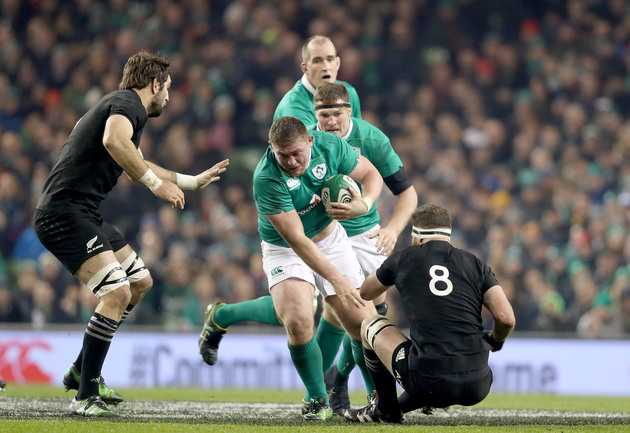
Tadhg Furlong with Kieran Read 19/11/2016

How did Kieran Read end up there?

However, for a team to have the widespread confidence to back themselves so thoroughly is something that can only be nurtured through winning games. The coaches’  roles are to prepare the side to the best of their ability, an area in which Joe Schmidt and his coaches are perhaps peerless. Once a side builds residual stores of self-belief, it becomes a different sort of beast. New Zealand have played like this for as long as most people can remember. Australia too, even when the quality wasn’t there, although that bullet-proof confidence seems to transcend all Australian sport. England displayed the trait most clearly in the eighteen month period leading up to their 2003 World Cup victory, and to their credit are always very capable of instilling self-confidence. Although, sometimes, like the occasion on which  Girvan Dempsey ruined their homecoming party, the English can get more than a little carried away.

Irish teams have often struggled down the years in this area. Obviously, Ireland lost numerous games because the opposition possessed superior levels of skill and fitness. However, we can all recall occasions, generally against France or the southern hemisphere sides where a mental block or failure to execute under pressure led to defeat. Often times, also, expectation has weighed too heavily and Ireland have underperformed: Wales in 2011, South Africa in 2016, the entire of the 2007 World Cup.

This current Irish side have benefitted from an extraordinary coach who leaves nothing to chance. As the players have learned to execute Schmidt and, latterly Andy Farrell’s tactics nigh on perfectly, and the fitness levels have increased, so too have they grown comfortable relying on their intuition in the crucial moments of a game.

Before we get too carried away with our recent success, it is worth remembering that the World Cup is almost three years away and recent events will be water under the bridge come 2019. Just ask the Starks. While the reality is that people can’t help but get giddy after witnessing the events of the last month, inevitable talk of a Grand Slam showdown with England on March 18th is presumptuous. The form graph is trending upwards for all Six Nations, and Ireland will need to tread particularly carefully in their competition opener in Edinburgh, against a Scottish side that will go wide early and often.

This week’s rather abrupt, and welcome announcement regarding the trial of the bonus point system in the 2017 Six Nations means that the competition is at last willing to part with tradition, often a meaningless, bye-word for those aspects of the tournament which people think they enjoy but can’t quite pinpoint. Pragmatism shall prevail though and there will be few who expect these new incentives to create a try-fest in a reliably, grim Dublin in mid-February. Still, even if attacking benefits won’t be reaped until March, sides will still at least get a reward for enduring in a 15-9 defeat decided by the boot.

Of course, an English victory tomorrow would mean Eddie Jones’s men ending the calendar year unbeaten. Jones is arrogant, abrasive and, at least publicly, less than charming but there can be no questioning his success as a coach. Previously, he has successfully dragged a mediocre Australian team to a World Cup final, while memorably masterminding the greatest ever upset in World Cup history last year with Japan.

Now, Jones has exceptional squad depth and resources at his disposal and, though his approach couldn’t differ more from Schmidt’s, he possesses the same clarity of purpose. In a recent presentation to the RFU, Jones explicitly stated that he wanted to develop a secondary leadership group to achieve his ultimate goal: world domination by 2019 (in rugby). To his credit, the Australian never shirks a challenge and forces his players to accept pressure as a motivation. Apologists for the Australian are suggesting his antics are intended to shield the players from the media but we’re inclined to disagree as rugby players aren’t subjected to anything near the same relentless attention as footballers. Jones’ Mourinho-like abrasiveness walks a fine line but as history has proven, the antics of a winner will always be forgiven.

Time then to face back into a hugely important and intense window for the provinces before the new look Six Nations begins with renewed hope for all concerned. After a November of unprecedented success, that all began on the shores of Lake Michigan, Ireland face into the new year with enhanced vigour but they now move with a target on their back. The best sides thrive in this environment. Ireland should too.

Standard
Ireland, November Internationals, Rugby

How deep is the Irish Well?

Before we go  any further, let’s just park any grievances we have regarding last week’s encounter with New Zealand and their excessive physicality, cynicism or whatever you want to call it. The Kiwis came correct, as it were, for a brutal encounter and did everything they had to, including those illegal acts that Jaco Peyper and his gormless assistants should have punished.

Now, of course, like every other Irish person watching, we were irate at the time but perspective and clarity, naturally enough, follow the event. Are New Zealand dirty? No, but more importantly, who cares? In a game where you’re trying to physically dominate and suppress your opponent, teams will often do what they can.

The responsibility lies with the officials, in all sports, to draw the line at what is and is not acceptable. Take last week’s light heavyweight boxing championship match between Sergey Kovalev and Andre Ward in Las Vegas as an example. Ward, a Californian defeated the unified champion, Kovalev , a Russian, in a bout scored unanimously 114-113 by the American judges. Now, for those who watched the fight, you could say it was a mildly controversial call but certainly not a travesty or a fix.

a-ward

Andre Ward (l), like New Zealand, took advantage of a weak referee. (courtesy Forbes.com)

Ward, a frustratingly, brilliant technical fighter gained traction through excessive holding and wrestling with the much more, destructive puncher, Kovalev, almost from the opening bell. Now, referee Robert Byrd could have had a word with Ward early on regarding his relentless holding, particularly after Kovalev’s explosive right in the second, but he didn’t and the challenger took advantage. Kovalev likely lost poise, and more importantly power reserves, in the deceptively energy sapping clenches which ensued. This was an extremely smart move by Ward that could have been stopped by Byrd, but it wasn’t and now, hopefully, we get a chance to see a supremely pissed off Kovalev take on Ward in the near future. Digression aside, the likelihood is that in the rematch Kovalev’s camp will be at pains to ensure that Ward’s tactics are brought to the next referee’s attention early and often.

New Zealand and Andre Ward simply worked the referees. Peyper, is frankly, a useless referee when it comes to disciplining foul-play – you need only look to the violent, illegal hits on Dave Kearney and Johnny Sexton in Paris in February – so, on what reasonable grounds was he appointed referee this game? Surely, Ireland would have politely requested a superior, and if possible non-SANZAR referee, but Peyper was the incompetent lot they were given. New Zealand have nothing to answer for here. Or to borrow and criminally butcher the words of the great Mike Lowrey, ‘don’t hate the players, hate the ref, his grossly incompetent TMO, and maybe World Rugby just a little bit.’

On Saturday, Ireland and Australia will have to deal with Jerome Garces, a man who both sides seem to have a bit of beef with. On that note, let’s park the referee issue. Michael Cheika has made ten changes to his match day squad from last Saturday’s late resistance of France in Paris. It’s a strange and sad sign of the times for French international rugby when a southern hemisphere side targets the Parisian encounter of a winter tour as the opportunity to give a few players a breather.

Cheika and Australia will probably regard this as the lesser as the next fortnight’s challenges – England have been given a very manageable winter schedule – but he’s astute enough to know the challenges Ireland will bring. Assuredly, Australia will not allow Ireland the same control of possession as their defence is not in the same league as the Kiwis. And, in David Pocock and the returning Michael Hooper, they have two of the foremost ground technicians in world rugby.

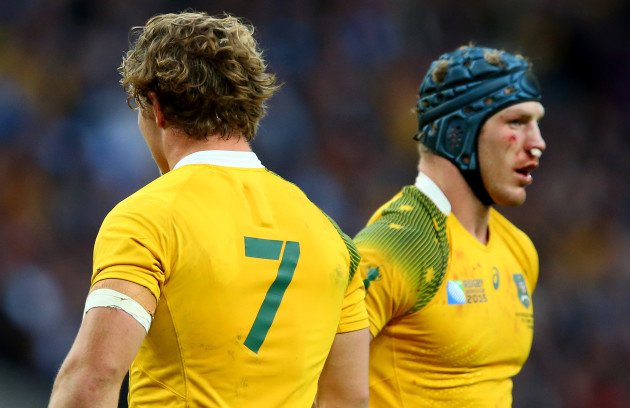
Michael Hooper and David Pocock 25/10/2015

Michael Hooper (l) and the bloodied David Pocock are probably still the best back row tandem in world rugby. (Yahoo Sport)

The pair performed extraordinarily throughout Australia’s surprising run to last year’s World Cup final and they will be integral to the visitors attempts to consign Ireland to back-to-back defeats. It’s going to be a relentless dogfight on the ground, and where New Zealand withdrew and realigned, Australia will launch themselves ferociously. Both will also look to use stolen ball to release Bernard Foley, the monstrous Kuridrani and potential, game-changer, Israel Folau.

Joe Schmidt seems to have found another well-balanced, back row, and it will be most instructive to see how Sean O’ Brien, Jamie Heaslip and CJ Stander perform against the two best back rows in the world on six days rest. O’ Brien was truly immense on his latest return from injury, carrying powerfully, dominating contact and, were it not a handling error, may have scored a decisive try. Heaslip appears to be playing his best ever rugby, with his unseen work now being accompanied once more by the powerful running so prevalent in Ireland’s 2009 Grand Slam run.

Meanwhile, Stander gets another opportunity to build on a fantastic performance in Chicago after his unfortunate departure last week. It’s probably a bit petty and whimsical but there’s a degree of schadenfreude in seeing Stander – who was apparently told he was too small for international rugby back home – emerge victorious against New Zealand while South Africa slumped miserably to record defeats, for very different reasons, against New Zealand against Italy. Stander’s rise has been prolific, after a difficult first season in Munster, and his raw passion and abrasiveness have made him a firm favourite with Irish rugby supporters. If anything, his success and popularity only further muddy the waters of the three-year residency rule.

Ireland’s midfield is, barring a frenetic hour last Saturday, a new one and Gary Ringrose, not unlike Gordon D’Arcy a decade or so ago, gets moved into his less preferred inside-centre role. Joe Schmidt has anticipated the physical threat that the hulking, Tevita Kuridrani brings and, probably wisely, has chosen to leave Jared Payne as the defensive lynchpin at thirteen. Kuridrani somehow manages to mobilise his massive, 6 foot 4, 16 stone frame into something more volatile than advertised and is an incredibly direct and destructive runner. The Fijian-born, thirteen and his centre partner, Reece Hodge, have scored in every game on this tour so far, and will be looking to match the exploits of Mark Ella on Australia’s 1984 ‘Grand Slam Tour’. Still, this Australian team just doesn’t have the look of a ‘Grand Slam’ about them.

Wales, who are very difficult to judge at the moment, were swept aside with admirable ease, Scotland pipped at the post, and France just about repelled so it would be remiss to compare this side’s feats thus far to the exploits of Farr-Jones, Ella, Lynagh and Co. in 1984. Australia have weaknesses that Ireland will be looking to exploit, mainly at the set piece. The home side’s lineout has functioned exceptionally all month and, while Australia has chosen for the cautionary inclusion of Dean Mumm on the blindside, Devin Toner’s unit should hold the edge here.

Meanwhile, it’s probably fair to say that the scrum has surpassed all expectations this November. Jack McGrath is deservedly keeping a surging Cian Healy on the bench, while Rory Best continues to flourish in the role he was made for. However, it has been the performances of Tadhg Furlong at tighthead, an area of real concern until recently, that have given most cause for optimism. Just twenty-four, a teenager in tighthead years, the Campile man has excelled since Joe Schmidt brought him into the fold. While there were always cautious expectations that Furlong would develop into a serious player, his performances in Chicago and then a fortnight later have emphatically announced his arrival onto the international scene. The former, New Ross, youth standout thinks his ball-carrying isn’t one of his strong suits, but the strength involved in grounding three New Zealanders, including Kieran Read, would suggest otherwise. While Stephen Moore and Sekope Kepu return, it’s still advantage Ireland in the scrum.

Tadhg Furlong with Kieran Read 19/11/2016

Tadhg Furlong has been immense through the early stages of his international career. (courtesy Newstalk)

So for all the explosiveness in the Australian backline, they can’t live from scraps, although they have exposed Ireland on a number of occasions with breakaways on recent visits. Still, Joe Schmidt will have drilled the importance of ball protection into his players all week long, so you suspect an incident like the unfortunate, Luke Marshall’s against Canada would be detrimental to a player’s chance of selection in the Six Nations.

On the flipside, the issue remains that for all Ireland’s evident forward dominance, the backline play can appear lacklustre with players sometimes slow to look for the offload and lateral movement often prevalent. Ringrose and Paddy Jackson were thrust into a war zone last week, and while the former found his feet,  it was difficult to make any assessment on Jackson.

In Jackson’s defence, there are few sides, if any, who would be able to attack cohesively after losing their midfield axis. New Zealand also would have struggled last week if the outstanding Beauden Barrett and Anton-Lienert Brown had departed so early. The Belfast man is a technically gifted player who performs consistently well for Ulster, but Saturday offers a serious opportunity to quieten the Carberry uprising, for now, and take control of this slightly new-look Irish backline. Coaches pore endlessly over previous games and sessions to find the right combinations and then, sometimes, an injury comes along and forces a new one upon you. Jackson, a slick passer, and the fleet-footed Ringrose might just unlock an Australian midfield that will know little of them. Of course, to earn the right to play, the young Irish will have to be ready for Hodge, Kuridrani and whatever else the resurgent Bernard Foley throws at them.

Paddy Jackson

Paddy Jackson’s performance tomorrow will have a huge bearing on Six Nations selection.

If someone said to you on 1st November that Ireland would win two tests in the month, you’d shrug relatively happily and think, a win against Australia should always be savoured. Now, Chicago has happened and everything has changed. Defeat against Australia would bring a sense of deflation to the month’s end which, while unfair, is only natural. Beating New Zealand thrusts a side into the role of favourites and this is a position with which Ireland need to become more comfortable, particularly against their more illustrious rivals.

Australia are rising from a low ebb and the past three weeks will have rejuvenated Michael Cheika’s side. Further, the visitors would never be readily associated with terms such as ‘low self-esteem’ and they’ll fancy a crack off a side who are close to breaking up the southern hegemony.

Tomorrow requires one more massive push from Ireland after last week’s unusually, intense contest. Win and this will be the most successful winter in Irish rugby history. There’s just about enough left in the tank.

S.U.S. Prediction: Ireland by 6

Odds: Ireland -1 (Evens)

Standard
Irish Rugby, November Internationals, Rugby, Rugby Union

Seconds Out, Round Two!

As it turns out, all Ireland needed to do was get New Zealand on neutral soil, in a city sprinkled with a little magic and, most importantly, put in an outstandingly accurate and intense performance for nigh on two hours.

Bizarrely, considering the meeting between the sides in 2013, Ireland managed to fly into Chicago somewhat under the radar. AIG had gone to typically, ludicrous American lengths to promote the game as a showcase for the ‘AIG New Zealand All Blacks’ – the stadium announcer was unintentionally hilarious  – with Ireland seemingly appearing to make up the numbers.

Now, we’ll never know how distracted New Zealand’s players were or whether they really did underestimate Ireland but the pre-match atmosphere, punctuated by the atrocious violin rendition of the almost equally atrocious, Ireland’s Call, gave no intimation of an Irish victory. It is interesting afterwards, that even amongst the burgeoning, Irish 20:20 hindsight community, few were deluded enough to claim that they had predicted a win for Rory Best’s team.

And that, thankfully, is what separates we supporters from Joe Schmidt, his management team and this ever improving, Irish squad. Offensively, Ireland got almost everything right, virtually all of it premeditated, and while there some defensive lapses, Ireland’s discipline meant the New Zealanders were afforded few opportunities to attack in broken play. As Eddie Jones succinctly pointed out that for all their abundant qualities, “the Kiwis aren’t as good off structured possession.”

And, unstructured attack is the essence to New Zealand victories, particularly in the final quarter. When Scott Barrett ploughed straight through the middle for his 63rd-minute try, even the most optimistic Irish supporter must have had visions of the standard, New Zealand late flurry and a scoreboard that might suggest a relative stroll home. However, Ireland’s defence remained both calm and confident, typified by Andrew Trimble’s rush inside that forced an awkward pass to Julian Savea’s back shoulder and Conor Murray’s nation-rousing smash of Julian Savea behind the Kiwi goal-line.

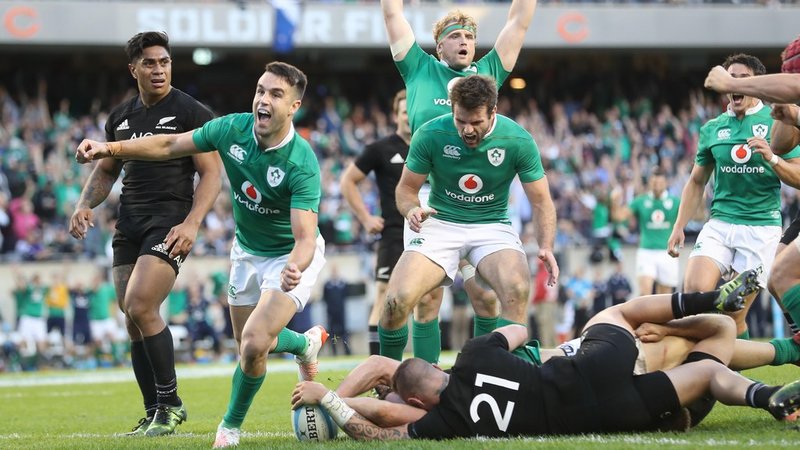
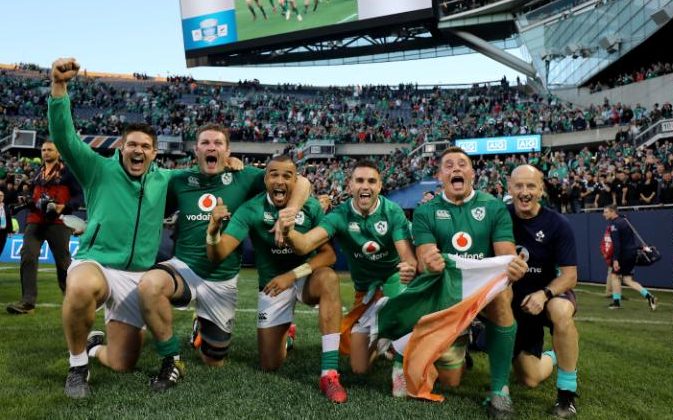
celebrations

Ireland’s, Munster contingent celebrate Ireland’s historic victory in Chicago (courtesy of the Telegraph)

Ireland did not hang on but, rather, finished emphatically with Robbie Henshaw’s try – one that just gets better with repeat viewings – so there is no sense that Ireland fluked a victory. That said, Irish people, not necessarily the Irish team, need to temper their excitement. Appearing on Off The Ball last Friday night, Brian O’ Driscoll good-naturedly observed that the Irish public really only seem to view this team in extremes after the presenters mulled over just how amazing Ireland might be. And, let’s not pretend we didn’t get caught up in that euphoria for a few days.

Meanwhile, on Second Captains Matt Williams – alumni of the same school of nonsense as Michael Owen – rambled endlessly about how important his views were while somewhat ludicrously suggesting injuries had nothing at all to do with Ireland’s World Cup exit. If you listen carefully enough, you can almost hear Williams suggest that Ireland are now playing to their true potential because Schmidt, at last, has seen the light and begun to heed the Australian’s advice. Some man, Matt!

Anyway, back to our visitors. New Zealand have never found themselves in this position before against Ireland so, as Brent Pope noted on RTE 1 Radio on Sunday, the real pressure is on Steve Hansen’s side, particularly back home where the expectations are exacting. Obviously, Ireland will be focused and determined but the longstanding, historical pressure has been alleviated after the victory in Chicago. New Zealand, having lost their undefeated record to Ireland may well feel the heat from their supporters if they lose consecutive tests to Ireland, despite only weeks ago being championed as the greatest team of all time.

After some amateur research, we figured that New Zealand’s win percentage when facing a team who has beaten them in their last encounter stands at 71 percent. Now, two weeks ago Ireland had a 0 percent success rate against New Zealand so, in relation to the largely unhelpful application of statistics to different teams through different eras, a 29 percent chance of success sounds just fine. Anyway, while we don’t know how Joe Schmidt’s mind works, one suspects he cares little for the historical response of New Zealand sides to defeat and more what they will bring to this particular contest on Saturday.

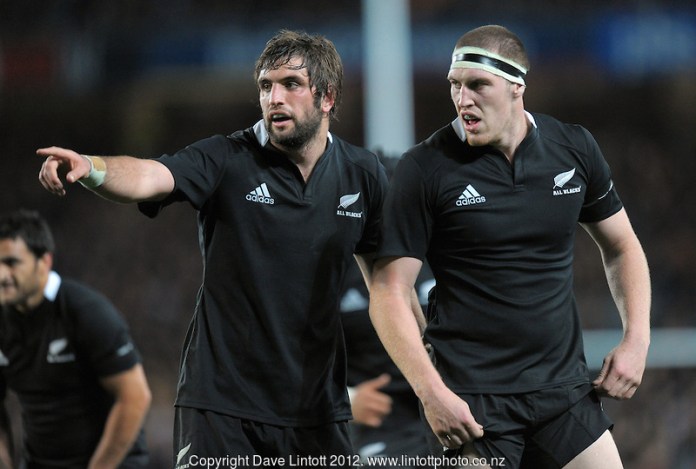
The return of the world’s best, though assuredly rusty, second-row pairing of Brodie Retallick and Sam Whitelock is a major fillip and it would be errant to think Ireland will enjoy the lineout dominance of Soldier Field. The returning duo offer the traditional skills of a lock, and in Retallick in particular, excellent ball handling skills in midfield, akin to Connacht’s 2015 star, Aly Muldowney.

Rugby Championship - All Blacks v Australia, 25 August 2012

The returning Sam Whitelock (l) and Brodie Retallick (r) could have a decisive effect on the outcome of Saturday’s match. (courtesy of http://www.lintottphoto.co.nz)

In midfield, New Zealand are down to their last men standing, Anton Lienert-Brown and Malakai Fekitoa, which may actually prove to their advantage as this is a more balanced 12-13 combination. Ireland, however, can claim superiority in this area of the field, as Robbie Henshaw and Jared Payne have developed a superb understanding, the odd rush out of the defensive line excepted. Even during the Rugby Championship, where New Zealand enjoyed near, total dominance, the feeling was that their midfield was relatively average, particularly compared to those who had come before.

Israel Dagg’s return will strengthen the back three, particularly in the aerial battle,  but you get the feeling that if New Zealand are to win, the returns of the aforementioned second-rows and Aaron Smith’s form will have a far greater influence. Conor Murray’s outstanding performances of late have called some to label him the best nine in the world , so Smith will hope to put his toilet issues behind him and remind those watching of his sublime, pre-summer form.

To counter this, Ireland need to find new points of attack, and for this reason, it is objectively, understandable that Sean O’ Brien starts for his near unmatchable ball-carrying skills. Josh van der Flier, excellent in his 55-minute shift in Chicago, is the one to miss out but, Schmidt picks players to do a job for the team. So, outstanding as van der Flier was a fortnight ago, the head coach obviously believes O’ Brien can offer more to the team from the off. Detached and simple. While van der Flier will care little for the irony of the situation, he was the man who replaced Tommy O’ Donnell in the starting line-up against England in this year’s Six nations after the latter had performed superbly off the bench in Paris in Ireland’s previous outing.

sob

Sean O’ Brien’s return should provide explosiveness and a new point of attack. (courtesy Getty Images)

Joe Schmidt will already have drilled all the fundamentals – accuracy, intensity, discipline- into his side, so it will be very interesting to see what new plans he devises, particularly with the likely negation of the set-piece as an offensive weapon.

If Ireland are to cause serious problems for the world’s number one side then Rob Kearney will need to back up his best offensive performance in years, supplemented by another career-best outing from Simon Zebo. The same could be applied to most of the Irish side, but the reality is they will somehow need to improve upon the performance of a fortnight ago.

Oddly enough, despite winning a fortnight ago, Ireland are the ones with more questions to answer, but this comes with the territory when facing New Zealand. The visitors are close to full strength, have a score to settle in their minds and will feel they owe themselves and their coaching team a vastly improved performance. Ireland were so deservedly victors on that incredible afternoon on the south side of Chicago, but we all knew that Retallick and Whitelock’s absences presented a huge opportunity.

While we wrote about intangibles and the atmosphere in a city gone mad, clutched at straws basically, to suggest we could even get close last time, the argument for Ireland should be more compelling this weekend. Also, any suggestion that Ireland will tire in the final quarter seems moot as the entire team bar O’ Brien had last weekend off and the chances are the Tullow man may only be used for an hour. New Zealand, however, have been badly stung and they will not be complacent this time.

Still, Ireland have the opportunity to be the first side to go back-to-back against New Zealand since South Africa in 2009 and a lot of this Irish team will be facing the Kiwis in a red jersey next June. New Zealand’s players assuredly cannot imagine or allow for a scenario where they could lose three in a row to the same opponents. They should escape with a victory, but only just.

SUS Prediction: New Zealand by 6

Tips: Ireland +8  (2/1)

           Ireland to win (6/1)

New Zealand  -16 generally.

Standard
Chicago, November Internationals, Rugby, Rugby Union

Why Not Us?

So, to the biennial consideration as to whether Ireland can finally break their duck against the all-conquering world champions, New Zealand. If Ireland’s summer trips to New Zealand are greeted with trepidation and the autumn games in Dublin give us some semblance of hope, where does a first ever foray into a Chicago test leave us?

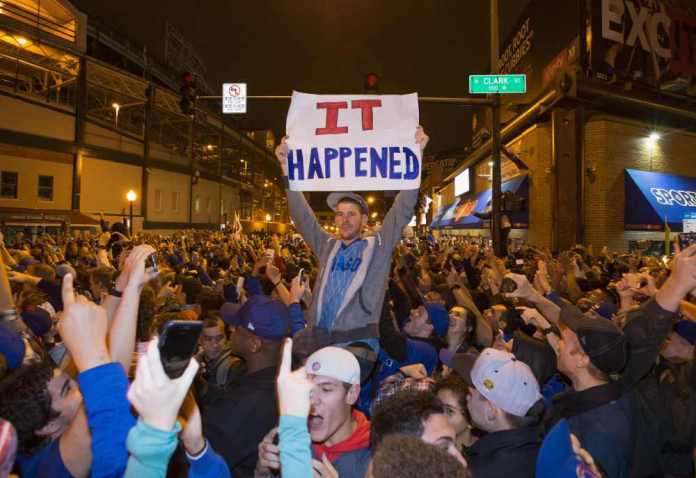
Well, for those who, like us, readily invest in fate, luck and the other intangibles, the Irish team need look no further than the north side of Chicago for inspiration. In the early hours of Thursday morning, the Chicago Cubs ended a 108 year World Series drought with the most heart-stopping, endlessly thrilling  victory over the Cleveland Indians.


AFP AFP_HQ3UC S BBO USA IL

Celebrations in Wrigleyville began in the early hours of this morning after the Chicago Cubs ended a 108 year World Series drought.


Even for those who loathe baseball, the game still involved enough twists for an entire season. The Indians, luckless since 1948, will be distraught but the atmosphere in Chicago will be absolutely electric for the coming days. And, hopefully, the Irish rugby team can feed off this. Granted, Soldier Field is on the south side in White Sox territory, but the jubilation will be felt throughout the city when the Chicago River will, apparently, run blue as the parade cascades through Wrigleyville tomorrow afternoon.


In the 108 years that the Cubs sought to break their drought, the Irish rugby team have been thwarted continuously in their own attempts to beat New Zealand. There have been near misses, never more so than 2013, nonetheless the task on Saturday remains as daunting as ever.

crotty-try

Ryan Crotty’s last-gasp try, converted by Aaron Cruden saw New Zealand defeat Ireland in 2013 in heartbreaking circumstances.

It’s very difficult to explore any narrative that hasn’t already been advanced going into this game as the New Zealand juggernaut has eventually rolled over every team it faced this summer. That’s not to say every encounter in the Rugby Championship was a completely, one-sided affair – Argentina, in particular, offered considerable food for thought – but each contest ended with a bench inspired, New Zealand onslaught.

Using your substitutes to up the intensity and energy is hardly an abstract concept – Kilkenny and more recently Dublin have perfected the art – but when New Zealand’s starting fifteen have been testing their opposite numbers lungs for 60 minutes, the ploy becomes devastatingly effective. Indeed, in an interview earlier this week, Lions coach and world-class troll, Warren Gatland noted that the results from the GPS tracker used on New Zealand evidence the claim that their players simply cover more ground than their opponents.

The brain is inclined to slow down as the body does and this is when New Zealand pounce. When allying this mobility with their redoubtable ball handling skills, awareness of space and acuity of decision making, this particular edition of New Zealand becomes increasingly difficult to plan for. Gordon Darcy’s article in Wednesday’s Irish Times expertly highlighted the way Irishmen began making poor decisions in the final three minutes in the 2013 encounter as a result of being out on their feet.

Everybody presumed that the collective retirements from New Zealand rugby of Dan Carter, Richie McCaw, Ma’a Nonu and Conrad Smith would create a contest at the top but in 2016 Steve Hansen’s side appear to have moved up to a new level of ruthless efficiency and precision.

And, perhaps to the fore of this team’s successes is its ability to ensure the machine keeps evolving to the point that when the above-named quartet retired, their importance to the team had possibly been surpassed by the Smiths, Ben and Aaron and Kieran Read. The best teams, the ones that seem to move on effortlessly and without fuss always have one eye on the future.

So, what chance do Ireland have on Saturday? They’re shorn of serious ballast in Sean O’ Brien, Iain Henderson and Peter O’ Mahony, the latter of whose exclusion seems slightly perplexing in light of his recent performances. Still, Joe Schmidt sees these players every day and with three tests to follow, the head coach can’t simply throw caution to the wind and still potentially end up on the end of a pummelling and without key players.

Ireland’s performance in South Africa this summer were extremely encouraging, particularly in the first test when they played 20 minutes with just thirteen men on the field. A series victory was denied by some basic individual errors and, for want of better analysis, a lack of good fortune.

Granted New Zealand gutted South Africa last month, but South Africa have actually regressed since June, played putridly on the day and allowed New Zealand dictate the game as they pleased. To brush over New Zealand’s performance would, of course, be careless at best as they were absolutely sublime in every aspect of performance and they exhibited what awaits Ireland if performance levels, or heads, drop in Soldier Field.

Ireland, having never played New Zealand in Soldier Field are, of course, undefeated there so there’s also that desperate crumb of comfort to cling to. However, on the face of what’s gone before and the current standings of the sides, does Rory Best’s team have a realistic chance of victory? Unfortunately, the honest and pragmatic answer would appear to be, no. However, let’s try and scratch a little deeper.

It seems that New Zealand’s vaunted second-row pairing of Sam Whitelock and Brodie Retallick will both be missing so this somewhat softens the blow of the absence of Henderson, O’ Mahony and O’ Brien. You can argue that New Zealand will be running out of steam after a long, test summer but, surely, having games under your belt is superior to a handful of training field sessions since late June. But after that, it’s hard to find an objective viewpoint to favour Ireland.

pom-and-ih

Ireland will really feel the absence of Peter O’ Mahony (l) and Iain Henderson (r) and Sean O’Brien in Soldier Field.

New Zealand are superior at every position on the pitch, bar perhaps first centre and the second row, and while scarcely believable, the sum is actually better than the parts. That cliché is usually reserved for a team like Leicester City’s premier league winners or Connacht’s reigning Pro 12 champions, a collection of ‘characters’, journeymen and enigmas patched together and proving their worth to all the doubters. But, it also rings true for New Zealand. Their centre pairing does not jump off the page, nor will the second-row pair – Jerome Kaino could yet excel in this role- and yet as the game unfolds it seems as if the fifteen individuals are performing as one, almost preternaturally in sync.

While it may seem dismissive of Irish supporters to expect defeat on Saturday, this attitude is more as a result of New Zealand’s grim stranglehold over the game for the past two years. Ireland have a chance, of course they do, but it will take a bit of adventure and guile to really get at New Zealand and it appears that Joe Schmidt, through a combination of necessity and choice, will be reverting to a more pragmatic game.

Ireland will need to perform at somewhere close to perfection in terms of accuracy, decision-making and defensive intensity while relying on every bit of luck to go their way. In this era of painful over-analysis, those obsessed with statistic evaluation hate to acknowledge that fortune, or lack thereof, can have a massive impact on the outcome of a game. For all their qualities, the unexpected rain shower last night may have been the decisive factor in the Chicago Cubs’ historic victory.


soldier-field

Soldier Field, on the banks of Lake Michigan and home to the Chicago Bears will play the unusual home to an Irish rugby fixture.


Nonetheless, it would require a borderline, delusional optimist to go into Saturday’s encounter expecting an Irish victory. And yet, here we are in the city where one of sport’s longest, most famous droughts was just ended. Look, we’ve never beaten  New Zealand anywhere so it’s not like we’re out of our comfort zone. Still, it would be remiss of us to look past anything other than a New Zealand victory. And yet………

New Zealand by 8


Standard
#Boxing, Boxing, GGG

It’s Triple G Time in London

Someone’s ‘0’ has got to go on Saturday night in London. Gennady Golovkin (35-0, 32 KO), whose frustrating pursuit of Canelo Alvarez remains unfulfilled, meets undefeated British welterweight Kell Brook (36-0, 25 KO) for the Kazakh’s WBC and IBF middleweight titles. Brook, IBF welterweight champion, will step up two weights in a matchup that is intriguing for many reasons, and more importantly one that we’ll be able to watch live at a decent hour.

GGG, whose mega-fight with Canelo is still under construction, heads to London for the first time to face what may well the biggest challenge of his career to date. There is no question as to whether it is Brook’s. The Sheffield native has pursued his countryman, Amir Khan, for years now only to be arrogantly dismissed, but after the latter’s career-stalling knockout at the hands of Alvarez in May, it is Brook who is stepping up to an even more daunting challenge against the most powerful puncher the middleweight division has seen for a generation.

sport

Boxer Kell Brook suffered a serious leg injury after a machete attack in Tenerife in August 2014.

Brook won the IBF Welterweight title from Shawn Porter in August 2014, but just weeks later was the victim of a vicious machete attack during a night out in Tenerife. After a hazy day and night’s drinking, Brook was left with a massive, gaping wound on his thigh that required 32 staples. The events of the night were never truly established but it is to Brook’s absolute credit that he was to return in March 2015 to make the first of three title defences.

Brook will have shed few tears to see Khan get dropped so shudderingly by the far-too-powerful Alvarez. However, Khan, the two-time former world champion was unwavering in the wake of his defeat, stating his intense dislike for Brook as the primary reason that they would never fight. Surely, in boxing of all sports, a hatred for your rival would be a massive carrot to step up and face them.

khan

Amir Khan (l) apparently won’t fight Kell Brook because he doesn’t like him.

Khan, though, as an alumni of future hall-of-fame trainer Freddie Roach’s Wild Card Gym, still has relative box-office draw in the US and would clearly prefer take a loss to one of the stars of the US market, rather than suffer the potential ignominy of defeat to a guy who he has always regarded as being beneath him.

Despite this discord, Khan will not have entered Brook’s thoughts in recent months as he knows he is going toe-to-toe this weekend with a freakishly powerful man. He’ll also be aware that going twelve rounds at the O2 may require the greatest performance of his career to date. While detractors of Golovkin always point to his so-so resume, he has never sidestepped a fight, more he has been forced to endure games of cat and mouse with crafty promoters.

To be fair, anyone who has stepped in the ring with Golovkin in the last two years has been absolutely decimated, so for Golden Boy et al. there is the fear of seeing their top draw get absolutely pummelled. From a practical – see commercial – perspective, it is easier for a boxer to return after defeat to a back foot technician over twelve strategic rounds than it is to pick themselves up from a jarring knockout defeat. George Groves career was completely derailed by Carl Froch’s right hand in 2014, while Khan’s stock, as discussed, has clearly plummeted.

https://www.youtube.com/watch?v=6z-YUG9ziSs

In October of last year, Golovkin ruthlessly took apart David Lemieux, then IBF middleweight champion, in eight glaringly one-sided rounds. Last time out after a blitzkrieg of the mandatory challenger, Dominic Wade, GGG had to listen to some bullshit prevarication from Golden-Boy, who seem to want the champion to come to Mexico City and fight strictly under their stipulations. A bout with Billy-Joe Saunders was never a reality, while Chris Eubank Jr’s chances of a shot at Golovkin seem to have been waylaid by an overly nosy parent.

So, it falls to Brook, an underrated fighter to jump two weights and attempt to pull off one of boxing’s greatest ever upsets. Brook, for whatever reason, never really made it outside the UK market but himself and Eddie Hearn, the chief of Matchroom Sports, have seen a once in a lifetime opportunity present itself.

Brook seem eminently confident going into this fight but in a game where the combatants willingly permit themselves to indulge in fantasy prior to fight night, why wouldn’t he be? For Brook, who has always been a big welterweight, a jump up the weights was probably on the cards, but not two levels and not to face an absolute wrecking ball.

The first instinct, after Khan’s defeat to Alvarez, was to predict an equally grizzly end for Brook. However, Brook will probably never return to 147 pounds so it’s not like he’s just coming up for a look, and he looks physically the match to Golovkin in the flesh. He’s got really good speed, and a great chin  – admittedly against welterweights – but speed and a chin make for good bedfellows.

On the flip side, however, you have to question whether the extra weight will actually equate into a more powerful boxer, yet one who also maintains his speed? What made Manny Pacquiao such an incredible boxer was his ability to win world titles in eight divisions while maintaining both these physical attributes.

More often that not, in any sport, extra muscle equals decreased mobility. After some supreme hand speed, Once Were Warriors antihero  Jake the Mus nonchalantly observed that his fallen foe had used “Too much weights, not enough speed work” and there’s merit in this observation.

In this fight, Brook’s speed is his greatest ally and it appears that his best chance of victory lies in winning a boxing match as opposed to a toe-to-toe fight with Golovkin. The risk with adding this weight is that his greatest attribute is now hugely nullified. Of course, you can argue either way but surely it seems Brook is playing into GGG’s hands by climbing all the way up to 16o. Brook is now, of course, proclaiming that 160 has always been his natural weight but why only make the jump now?

Again, we shouldn’t get caught up in the pre-fight hyperbole and while Brook did look in exceptional shape at the weigh-in, the lingering concern remains that he is stepping up for the first time to face the best there is in the middleweight division.

Brook won’t face the same strength issues as Khan but if this detracts from his speed and allows Golovkin close down the ring early then it’s game over. If Brook boxes patiently for the early rounds and makes it past nine, then this fight is live. Golovkin is coming to fight in hostile territories – though he strikes you as a guy who’d fight anyone, anywhere, anytime – and if the power game doesn’t pay dividends early he may become unsettled.

However, GGG is a brilliantly precise boxer, and his only perceived weaknesses are based on conjecture. Brook is the one who needs everything to go right and even if it does, he may not win.

If Brooks greatest attributes haven’t been compromised then tomorrow night has the potential to be the fight of the year. The feeling is, though, that the jump in weight will come at a price. Golovkin will want to thrill on his UK debut. And we’re inclined to think he will.

Straight Up Sport Betting Tips:

  1. Gennady Golovin to win in the 9th @ 12/1
  2. Both fighters to be knocked down @ 12/1


Standard