Rugby

RWC 2015 – Ireland -v- France Preview

Ireland Hopefully Cooked to Perfection

With the potential crisis averted last weekend, Ireland head to Cardiff in a historically favourable position – angry and with a point to prove. In the immediate aftermath of Sunday’s game, it was hard to escape the feeling that Ireland had, probably subliminally, gone into the Italian job with one eye inescapably on France seven days later. Obviously we here it on rote these days that the players are professionals, that they don’t listen to outside noise and take each game as it comes. All the available empirical evidence would suggest otherwise. Did South Africa approach Japan as they would have the All Blacks? Certainly not. To a far lesser extent Ireland appear to have entered last Sunday’s game with their focus and intensity askew. And at this level as we’re repeatedly told, you only need to be one percent off your game to be exposed.

From the off it seemed that the Italians were quite simply better prepared for a battle, ably facilitated by Ireland’s soft defensive line. Now, as far we understand, the intention here is to guide the attacking side laterally ultimately using the touchline as an extra defender. How in the world though does this justify giving the Italians twenty-five easy metres off a scrum, simply by shifting the ball wide? The line speed improved in the second half but dipped once more, particularly when Josh Furno’s try scoring opportunity was created. Ireland were listless at ruck time –not helped by the otherwise excellent Peter O’ Mahony’s yellow card for a rash, arm-free charge at the ruck- and quick ball was at a premium, save for when Iain Henderson carried.

When the ball was there, receivers took it deep from a standing position and were invariably stopped behind the gain line. The early connect between Robbie Henshaw and Keith Earls was truly promising but after the game’s only try, numbers eleven to fifteen were rarely required to focus on much more than their kick chase skills. With David Kearney and Tommy Bowe ostensibly taking part in an audition for one wing spot, both must have been truly disappointed at the paucity of attacking opportunities that came their way. Similarly, the uncomfortable looking Simon Zebo. There is no pint in engaging the Corkman to mimic Rob Kearney, not when their skill sets are so vastly different.

Watching Sunday’s game one couldn’t help but draw comparisons to the 2013 hammering by Australia which officially ushered in the Joe Schmidt era. That day the defensive line fell off while there was little or no direction in a completely anaemic attack. The following Sunday felt like a trip to the gallows with a peerless All Black side set to finish off their unbeaten year with a comfortable victory in Dublin. Of course, we all know how events unfolded. From minute one that day, the home side tore into their far more illustrious opponents, playing with heretofore unseen intensity levels for an Irish side, bringing the defensive line up quickly and carrying with support runners straight through the heart of the ruck. Simple rugby carried out with incredible accuracy and efficiency. And this is what Ireland must aim for again next Sunday in Cardiff.

As insipid as last week’s performance was, Ireland still took four points from the encounter with no injuries reported. Irish teams invariably respond more favourably when they are cast in the role of underdog, or at the very least when they are not overwhelming favourites against a competent team. To be quite blunt about it, sometimes a kick in the arse beats a pat on the back.

Joe Schmidt has already indicated that perhaps the most frustrating aspect of the performance was the concession of ten penalties –Peter O’ Mahony, though superb, was pretty much namechecked by his coach in this regard- and despite the widely held theory about holding back our hand, teams don’t intentionally display bad discipline as a ruse. This is the first area that needs to be rectified for Sunday. Beyond this, of course, we move to the great unknown, the magic tricks which Schmidt and his coaching team have been concocting since the squad first gathered during the summer.

We’ve possibly beaten all our poker analogies to death at this stage so suffice to say, Cardiff will be the stage where Ireland’s backline makes its big reveal. Our half-backs, amongst the best pairing in the world, need to perform this week as we know they can. There was something disconcerting about watching Jamie Heaslip feed Conor Murray off an attacking scrum, whereupon Murray grubber kicked straight to touch. None of the other eight potential quarter-finalists would have attacked off first phase in this manner –to their credit Ireland did a job on the Italian lineout but it’s a pretty limited mode of attack- so again let’s presume that this is all part of a giant Kayser Soze-like deceit.

Of course, what everybody wants to see more than anything is a backline with the potential to unlock their opponent’s defence, by trickery or otherwise. Under Philippe Saint-Andre, France may have lost their attacking verve but they have developed an extremely aggressive in your face defensive wall that simply will not be unlocked by a series of predictable wraparounds. However, in Joe Schmidt’s tenure Ireland have become extremely clinical, so just a handful of line breaks will be sufficient to set up decent attacking platforms. We suspect that February’s game against the French in Dublin provided a pretty accurate blueprint of what we’ll see in Cardiff: direct carries in midfield, trench warfare on the ground and aerial bombardment.

Up to this point, possibly due to our shamefully presumptive nature, we have focused solely on Ireland –Sergio Parisse aside- prior to each group match. This time, however, it would be remiss of us to ignore the challenges that France will bring. On current form, the French have by far and away the most effective ball-carrier in either pack, in Louis Picamoles. The number eight simply cannot be allowed boss the collisions as Parisse was, and if gets into open field he can be as destructive as any of the French backs. The Toulouse is assisted by the no-frills Bernard le Roux* and their redoubtable captain, Thierry Dusautoir. Without a shadow of a doubt, this unit will provide Ireland with their greatest challenge since Wales in Cardiff last March.

Sean O’ Brien is Ireland’s obvious wrecking ball yet it is the perceived dirt merchant in the back row, Peter O’ Mahony, who has actually been our most effective carrier within the unit. Once more the question arises as to whether we are picking the right back row combination? It seems highly implausible that either O’ Brien or Jamie Heaslip will be dropped -though Sunday requires a marked improvement in performance from both- so if a change is to take place it would be likely be the heretofore highly impressive –both in open play and in a highly functioning lineout- O’ Mahony dropping out. And yet…..
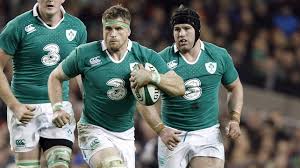
Ireland need big performances from Jamie Heaslip (centre) and Sean O' Brien (right) on Sunday evening.

Ireland need big performances from Jamie Heaslip (centre) and Sean O’ Brien (right) on Sunday evening.

O’ Brien has grown into the role of poacher but one wonders if this has nullified his carrying threat? Where are the barnstorming runs last seen as recently as March in Murrayfield? Would a move to number eight at Heaslip’s expense or six at O’ Mahony’s with Chris Henry – Ireland’s best ground operator in the contested areas- coming in at open-side in each case be logical moves? These are options that we have touched on before and even if we don’t believe that immediate change is necessary, there is merit in considering these alternatives. If O’ Mahony, Heaslip and O’ Brien can fulfil their respective roles of disruption, control and destruction then Ireland will assuredly have the upper hand. If, though, as the game unfurls the French are preventing a flow of quick ball in Conor Murray’s direction then Henry must be introduced. Our best back row is still the unit that started last Sunday but the situation remains fluid.

One recurring, slimmed down though still sizable, problem that Ireland must face is the potential match-winner Mathieu Bastareaud. The Toulon centre has always caused trouble for Ireland, whether with the now retired Gordon D’Arcy and Brian O’ Driscoll or one of Bastareaud’s current targets, Johnny Sexton. That last statement is probably a little disingenuous as the destructive Bastareaud’s remit is to damage the body and weaken the mind of all out halves, not just Sexton. If he gains momentum and crosses the gain line , Bastareaud has the Ma’a Nonu like ability to free his hands and facilitate the French second wave.

Ireland need to nullify the line-breaking ,off-loading threat of Mathieu Bastareaud.

Ireland need to nullify the line-breaking ,off-loading threat of Mathieu Bastareaud.

The rule for Bastareaud –not dissimilar to the one employed so  successfully by Wales four years ago to foil O’ Brien and Stephen Ferris- will be to hit him as early as possible, ideally behind the gain line. The position in which the big midfielder gets the ball is intrinsically linked to the quality of the ball laid at the feet of Morgan Parra. Slow ball allows the Irish line to shoot up quickly, hopefully foregoing the passive approach seen at the Olympic Stadium. Also, as Gordon D’Arcy pointed out this week, Robbie Henshaw is a pretty big unit, well capable of halting Bastareaud on and not over the gain-line. Nonetheless, the best one can hope for with Bastareaud is containment as he is quite simply too big to overpower or dominate.

Which leads us to maligned, then popular, then oddly maligned once more and now seemingly due to his absence, popular again, Jared Payne. Who knew kicking the ball three times in a tournament could get you on the wrong side of that old sage, Matt Williams? Payne will bring renewed stability to the Irish midfield while guaranteeing crucially important go-forward ball and largely underappreciated distribution skills. Payne and Henshaw had developed a decent understanding by the end of the Six Nations but further growth has been stymied by the unavoidable intervention of injury. Now, as a friend pointed out to us recently, the World Cup is not being played exclusively by centres but the outcome of this game within a game on Sunday will prove absolutely crucial.

The biggest questions will be asked of Ireland when the benches empty around the hour mark. Cast your mind back eight months and you will recall the breathless finale as Ireland desperately repelled wave after wave of French attacks, the latter supplanted by twenty stone monsters off the bench. We have a feeling that this is precisely how Sunday’s encounter will finish, a frantic endgame with the sides camped in the Irish twenty-two.

Sunday is not do-or-die. To say otherwise would be plainly hyperbolic as both sides will get at least one more bite of the cherry. What it is though, particularly for Ireland, is an opportunity to enhance their credentials as genuine World Cup contenders. Interestingly no side has ever won the tournament after suffering a group defeat and it would be preferable if Ireland didn’t have to buck this trend.

Ireland arrive in Cardiff more or less exactly as we expected, predicated of course on the fact that we have thus far only had a glimpse at the full armoury. France, wired as they are –uniquely- simply know how to step it up in World Cups. That statement would sound lazy if it wasn’t so patently incontrovertible. It will come down to fine margins and we’re inclined to back a hopefully even angrier than usual Johnny Sexton over the admittedly resurgent, though still flaky, Freddie Michalak.

Two roads diverge in Cardiff on Sunday. It would be preferable if the one through New Zealand was the road not taken. Ireland by a whisker.

*Damien Chouly has been selected at blindside flanker ahead of Bernard le Roux.

Prediction: Ireland by 2 (Ireland -2 generally)

S.U.S. Tips: (i)  Handicap draw 22/1

(ii) Draw 16/1
Standard
Rugby

Rugby World Cup 2015 – Round 3 Preview

Payne once more the butt of unjustifiable criticism

The chaos and carnage in Twickenham on Saturday night was unquestionably the high point of week two in this simmering World Cup. The compelling and mystifying –because frankly how in the world did Wales win- contest provided exactly what we all expected with the already battle-scarred Welsh forced to reach deeper than most thought possible. Gutsy and intensely composed as the Welsh were in the final quarter, England have massive questions to ask of their leaders, both on and off the field. As many had noted beforehand England’s team selection suggested a desire to stifle their opposition rather than playing to their own strengths. Wales are bloodied and will need incredible resilience to turn around for Thursday’s encounter with Fiji but Gatland, like him or not, has engendered an incredible sense of desire and character within his Welsh squad.

The idea abounds in this professional era that players are no longer driven by passion but by a natural professional drive to win. Gatland has long been criticised for his over-reliance on feeding his players emotions but this weekend he worked his players into a perfect frenzy. With bodies strewn across the pitch and an almost unbelievably patchwork backline out there, Wales’ character and passion were to the fore. The danger with this approach, of course, is that players can’t simply be expected to call on these deep resources of emotion each time they require a herculean effort. Nonetheless, when the situation required it last Saturday evening, a logically inferior Welsh side were able to out battle their more vaunted hosts.

Ireland -remarkably in front of a world record attendance for a Rugby World Cup- easily and expectedly downed a limited Romanian side with the back three, in particular giving Joe Schmidt serious food for thought. With Rob Kearney in doubt for next weekend, this same back three may well be asked to take the field again although at this point it’s a coin toss between Tommy Bowe and David Kearney for the right wing slot. The most intriguing aspect of Ireland’s performance has been the criticism aimed in the direction of Jared Payne. The converted full-back has obviously been under intense scrutiny since replacing Brian O’ Driscoll in midfield, a truly unenviable task no matter who you are. Payne, though, appeared to have ridden out the storm, most recently receiving the endorsements of none other than O’ Driscoll and his midfield partner of many years, Gordon D’Arcy, both of whom acknowledged Payne’s outstanding defence and distribution skills.

On Sunday evening, however, (Irishman?) Matt Williams lamented Payne’s complete lack of form, suggesting Darren Cave would be a suitable replacement in midfield. Worse still the rest of the panel were inclined to agree with him. Now with all due respect to Cave, who is a fine player, his best moments against Romania came in the second half, against a team not exactly renowned for their strengths in midfield. Payne was by no means outstanding on Sunday and his kicking is pretty abysmal judged against any standards. But, given that his kicking game needs to improve, he was right to experiment during those games in which Ireland have virtually no chance of losing.

Look back to the defeat in Twickenham last month and you will recall that Payne was the outstanding back on the Irish team. Frankly we’d side with the guy who steps it up against the better sides, notwithstanding the fact that his performances in recent weeks haven’t really been all that bad. Jared Payne is the best available distributor and defender at outside centre at this moment in time. Darren Cave and Keith Earls though able replacements are not superior second centres to Payne. Robbie Henshaw may ultimately be the man who to naturally fill this position, indeed one hopes so, but right now we are only concerned with the next five weeks.

One can’t help but wonder if there is an underlying antipathy allied with an increased level of expectation towards Payne based solely on the fact that he is a naturalised player. For years, we have looked down our noses at the All Blacks, Australia and more recently England for their recruitment of perceived rugby mercenaries. These players, wherever their place of birth, and their adopted nations are simply taking advantage of an IRB rule. Their performances should not be held to a higher standard and nor should they be subjected to the South Park treatment.

Jared Payne's performances continue to be questioned by the media.

Jared Payne’s performances continue to be questioned by the media.

In any event, the negative talk about Payne has been widely disregarded by those in the know –Darcy and O’ Driscoll- and earlier in the week those who matter. Tommy Bowe, in an interview with The Irish Times indicated that Payne clearly has the backing of his peers while indirectly suggesting that Matt Williams’ views are perhaps best sprinkled with salt. Or at least that’s our interpretation. Williams doesn’t seem to be the most popular pundit, not helped by, amongst other things, his Colin Montgomerie- like ability to insert ‘I’ and ‘me’ into every answer, even when the question is not remotely related to him.

Moving on, Ireland go to East London on Sunday to face Italy knowing that at last the intensity is going to be ratcheted up. Sergio Parisse’s return is of immeasurable value to Italy as heretofore they have been really poor and only snuck by Canada last weekend. The Italians came into the tournament in poor form and don’t seem to have escaped their funk.

Parisse is of monumental importance however and by simply playing he has an uplifting effect on those around him. Statistics obsessed observers, who are ten a penny nowadays, naturally prefer to rely on measurable data and often balk at the idea that totemic players- McCaw, Parisse and O’ Connell- can improve the performance of those around them by their mere presence on the field. There is room for a lengthy debate on this, but our main point is that Sergio Parisse will be more than a world-class number eight on Sunday. Simply by returning to the fold he brings renewed, infectious vigour to his teammates and forces them to try and raise their level of performance to the lofty standards of their captain.

This, however, will not be enough. Ireland have been quietly efficient thus far and all thirty players who have taken the field in the tournament have acquitted themselves well. Selection headaches have arisen as a result of an excess of quality performers as opposed to the 2007 issue of ‘where have all the good performers gone?’ It appears that Robbie Henshaw, an injury-enforced non-participant thus far, will make his World Cup debut alongside Payne, though Payne’s bruised foot may not heal in time. While the squad possesses an abundance of converted centres it would be preferable at this stage to have the first choice pairing together.

The balancing act at loosehead prop may see the unfortunate Jack McGrath shifted to the bench, but a fit Cian Healy will be extremely difficult to omit. Along with Sean O’ Brien and the surging Iain Henderson the Leinsterman provides a world-class ball carrying option and breaching the gain line is, of course, absolutely crucial. Another fifty-odd minutes for Healy would surely see him primed to go deep when Ireland will need him most against the French.

The back three also offers various conundrums, with all six players staking a valid claim to a starting jersey. Rob Kearney, the incumbent full-back, probably won’t be risked on Sunday meaning the increasingly impressive Simon Zebo will be entrusted with the role of minding the house. While Luke Fitzgerald impressed in the Six Nations finale his chances may be damaged by an appearance at inside-centre against Canada. That, and the fact that Keith Earls is probably playing the best rugby of his life. A confessed self-doubter the Limerick man looks incredibly confident and happy in his skin these days. A neutral observer would think that he is a lock for the number eleven against Italy, and perhaps beyond. If Payne is out, expect Earls to move inside and Fitzgerald to fill the number eleven jersey.

On the other wing, there is a little to choose between David Kearney, whose form of late has been outstanding, and old favourite Tommy Bowe. Bowe’s form had been patchy at best, plummeting to its nadir in Twickenham last month. However, last Sunday he performed like a man with a point to prove, dominant in the kick chase and finishing well twice, particularly for his first score, when he powered straight over the top of his opposite number before grounding the ball in the tightest of spaces. Kearney is also a fantastic competitor in the air and he, more than any other back in the last two months, has showed menace and ambition in virtually every carry. It would be cruel on the Louthman to miss out, but it will prove extremely difficult to omit a rejuvenated Tommy Bowe. Admittedly though Bowe has only found form in the last week so the likelihood is that whoever has gone better in training this week will be selected.

Never has an Irish coach been stuck with so many difficult though welcome selection issues. Credit here of course needs to go to Joe Schmidt and his coaching staff for developing a genuinely deep squad. There seems to be a near perfect balance of competitiveness, ambition and camaraderie. Time for the serious stuff now though. And, with a little bit of luck Joe Schmidt’s opinion will hold a little more sway than Matt Williams when it comes to team selection.

Ireland-v-Italy (possible 23)

  1. Cian Healy 2. Rory Best 3. Mike Ross 4. Iain Henderson 5. Paul O’ Connell (c) 6. Peter O’ Mahony 7. Sean O’ Brien 8. Jamie Heaslip 9. Conor Murray 10. Jonathan Sexton 11. Keith Earls/David Kearney/Luke Fitzgerald 12. Robbie Henshaw 13. Jarred Payne/Keith Earls 14. Tommy Bowe 15. Simon Zebo 16. Sean Cronin 17. Jack McGrath 18. Nathan White 19.Donnahca Ryan 20. Chris Henry 21. Eoin Reddan 22. Ian Madigan 23. Luke Fitzgerald/David Kearney

* At the time of writing there is major doubt over Jared Payne’s participation on Sunday. Per The Irish Independent, Keith Earls will be Payne’s likely replacement.

Weekend Picks (selections in caps)

SCOTLAND +14 over South Africa

IRELAND -19 over Italy

Standard
Rugby

Rugby World Cup 2015 – Round 2 Preview

For Lancaster, might is right

So, after a tumultuous week, all twenty sides have taken the field. No prizes for the highlight of the opening round of games but the cruel nature of the scheduling –where Japan were forced to play the two favourites in their group within four days- means Eddie Jones’ side were comfortably and none too impressively subdued by Scotland. Vern Cotter’s side has come to the table with little fanfare, largely as a by-product of consecutively awful Six Nations performances but they should not be underestimated. On Wednesday, the Scots, due to the whimsical nature of scheduling and matters out of their control, were treated with the sort of antipathy reserved for one of their near neighbours. True, the Japanese engines eventually stalled –too easy to insert a joke here- but Scotland were still very impressive in dispatching a tricky, confidence-imbued Japanese side.

We’re inclined to think that we dodged a serious bullet by avoiding a full synopsis of what is now the most interesting quintet in the tournament, Group B. Japan, would admittedly, have been given pretty short shrift. Still, with money in our hand we’d have no hesitation in predicting that South Africa and Scotland will escape will escape this group, though the order in which this happens has taken on a mask of uncertainty after Japan’s stunning victory last Saturday.

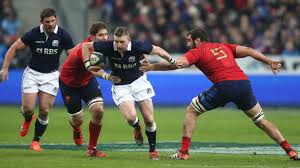
The elusive Finn Russell will play a big role if Scotland are to go deep in this tournament.

The elusive Finn Russell will play a big role if Scotland are to go deep in this tournament.

Scotland came into this World Cup with virtually no fanfare surrounding them. And, as somewhat of a quirk, until the IRB rankings are updated next week, they remain the fourth highest ranked side in Group B, behind South Africa, Samoa and Japan. We’ll say now, potentially to our complete embarrassment in a few weeks’ time, that this Scottish side -controlled by the increasingly impressive, Finn Russell, has an excellent chance of making their second ever Rugby World Cup semi-final. Naturally, there are a number of more easily fancied sides to choose from, but we’re inclined to think that the South Africans, rather than being even more dangerous now, are actually ripe for the taking. The ‘Boks enter a balls-out war with Samoa on Saturday and there is likely to be damage from this –actually and not collateral- not to mention the fact that the Samoans could turn over their wounded rivals. Scotland, like Ireland, have been well treated by the fixture list and the benefit of this really can’t be overstated.

Also this weekend, going hand in hand with the South Africa Samoa slobber-knocker, we have the clash of England and Wales in Twickenham on Saturday night. English coach Stuart Lancaster, to the chagrin of many, has made the dull and somewhat depressing decision –we’re talking bigger picture in this regard- of selecting the bread and butter Owen Farrell over the more creative, though admittedly slighter, George Ford for the pivotal clash with their western neighbours. The Welsh, under Warren Gatland, are now famed for ‘Warrenball’ – smash it up in midfield and win every possible physical collision. Lancaster, mindful of this, has chosen a mind-numbingly unimaginative English ten, twelve, thirteen connection of Farrell, Sam ‘the Second Coming’ Burgess and the one trick defensive pony, Brad Barritt.

Out-halves or first five-eighth –depending on where you’re sitting- have always been granted a sort of dispensation for both defensive ability and indeed physique. David Humphreys, Ronan O’ Gara and now, Quade Cooper have all enjoyed enormously successful careers despite clearly lacking the defensive presence of Jonathan Sexton, Jonny Wilkinson or Dan Carter. George Ford, by the grace of genetics, falls into the former group, a nimble twenty-two-year-old who invites plenty of challenging traffic down his channel. When it comes to defence, there is no question that Farrell enjoys clear superiority over Ford.

George Ford, seen here touching down against France in this year's Six Nations has been dropped by coach Stuart Lancaster for this weekend's pivotal encounter against France.

George Ford, seen here touching down against France in this year’s Six Nations has been dropped by coach Stuart Lancaster for this weekend’s pivotal encounter against France.

However, little more than twelve months ago, Ford was offered the number ten jumper to try and give some impetus to an English attack so plainly lacking in craft or guile. Ford’s arrival has been widely lauded and England’s outrageous victory over France in March, where there backline sparkled, was largely inspired by the innovation of the Bath man in the pivot role. Jamie Joseph, injured this weekend –and perhaps for longer- was probably the greatest beneficiary of Ford’s playing style so in Joseph’s absence, the need for a creative out-half has been, rather perversely, deemed superfluous.

Excepting that Barritt is, as they say in baseball, a defensive whizz only, Ford could still work wonders for the underrated line running of Sam Burgess. The Yorkshireman is lazily regarded by union fans as a battering ram -these the same fans who now fawn over Sonny-Bill Williams- but there is far more to the Yorkshireman’s game than catch  and smash. With Farrell inside, however, there is no chance of witnessing the more subtle aspects of his game.

Stuart Lancaster has proven his continued inconsistency in terms of his selection for this weekend’s centrepiece, with the omission of Ford. Already he has acceded to Warren Gatland, acknowledging that he is going to try go bang with the best in the business. The great shame, of course, is that Lancaster has shown to the world and more importantly his young out-half that when push comes to shove, quite literally, might will always be right.

The bigger issue here was highlighted by New Zealander Ben Smith in a Sunday Times interview last weekend. Smith, who spent a year in Bristol after high school–playing with Old Colstonians- noticed that after training everyone would head straight for the gym ignoring the idea of spending extra time on ball skills. Lancaster’s decision to drop Ford is merely a by-product of this disposition to strength over skill. Good defenders should never be taken lightly but ball-players, genuine game breakers like Ford and Finn Russell, should be cherished.

Standard
Rugby

Rugby World Cup 2015: Week 1 Review

Japan's players celebrate what may, perhaps, become the most famous try in rugby history.

Japan’s players celebrate what may, perhaps, become the most famous try in rugby history.

At dawn, look to the east……

New Zealand 145-17 Japan. 1995. England 111-13 Uruguay. 2003. Australia 142-0 Namibia. 2003. The early days of each edition of rugby’s flagship tournaments have always provided the unwanted spectacle of lambs wilfully making their way to the slaughter. Since 1987, the IRB, world rugby’s governing body have –admittedly with a lot of persuasion- attempted to develop and grow the game, particularly in the non-traditional hotbeds of the sport. The game of course needs to be promoted and spread –otherwise you get a self-serving administrative set up like that of cricket’s power-brokers- but there have been occasions, like those listed above, where one almost wished there was a mercy rule.

And so, we all tuned in, perhaps only semi-interestedly, to see by just how much Eddie Jones’ Japanese side would suffer at the hands of two time World Cup winners, South Africa. Two hours later, and with sitting-rooms, pubs and indeed, Cardiff, absolutely rapt, Karne Hesketh slid over in the corner to earn the most unexpected, though richly deserved, victory in rugby history. What happened in Brighton felt almost transcendental in its immediate aftermath –not of course that we would attach over importance to a game of rugby- and could well provide an incredibly-timed effect on the game of rugby in Japan, just four years before they host Asia’s inaugural Rugby World Cup. It is worth noting, however, that this result at least in the short term has probably had a far greater effect on established rugby playing nations than Japan itself –indeed the game was not even broadcast live there- but the hope is that such a momentous occasion will bear fruit in Japan in the next few years.

This victory needs to be spoken of in a different context to anything else that happened last weekend. How, in all rationality, can one consider Ireland and France’s facile –though entirely functional and impressive in their own right- victories over Canada and Italy when over in the other corner an upset of genuinely seismic effect had occurred.

This is not soccer, where the very style and physical requirements of the game facilitate upsets on a relatively regular basis. In rugby, the big sides –specifically the big three southern hemisphere sides- simply do not get caught out by some chippy upstart. The vagaries of the game mean that if a bigger side can’t find the key do the door, they’ll simply go straight through it. Just look at the circles in which these sides operate. Japan’s final pre- World Cup game was a defeat to the world superpower U.S. Eagles. South Africa, meanwhile, appeared to have turned the corner –the ‘Boks had lost their previous five- with an impressively, overpowering victory over Argentina in Buenos Aires.

As the game kicked off, there was an underlying feeling that this duel would provide viewers with the sort of dispiriting turkey shoot –you’re probably the only rich person out there if you felt otherwise- that make casual fans wonder what’s so great about the early stages of this tournament. And then a to and fro epic unfurled before a Saturday afternoon crowd which must have been wondering right up until the final quarter whether this was simply going to be a case of the Japanese dam bursting as expected. Indeed, Eddie Jones, their masterfully innovative coach, implied as much as he too feared the horror movie was about to unfold.

Japan’s last two tries, particularly taken in their context, are quite simply two of the best tries you will see over the next six weeks. The first, by Ayumu Goromaru was straight out of the school of Jones, a wonderfully crisp move off clean lineout ball, punctuated by a beautifully timed inside pass to breach the green line.

The winner was impressive for multitudinous reasons. Eschewing kickable penalties to draw with you know, just South Africa, might seem fanciful for one of the stronger nations yet Japan’s players didn’t even contemplate the alternative. And there is no way that one could argue with their logic. Here they were, in an all all-time position to register the most amazingly shocking result in the history of a game that dates back to the nineteenth century. Never mind ‘The Catch’ or the ‘shot heard around the world’ from the grossly hyperbolic world of U.S. sports. Hesketh’s try and Japan’s Eddie Jones-inspired victory will reverberate in a way that nobody in their wildest dreams could have imagined.

Japan have ensured that they will be treated with a level of respect which they surely could not have anticipated prior to Saturday’s miracle. The cruel nature of the schedule means qualification will still be a brutal struggle but confidence can’t be an issue now. Jones, ever witty, had this to say about upcoming opponent’s Scotland, It’s interesting that before the tournament Scotland said we were going to tank the first game. So if we did tank the first game we’ve got a good performance coming up in our second.”  Eddie Jones, sardonic to the end, sadly leaves his post after the tournament but hopefully not without adding to the greatest upset in rugby history. That said, with Japan now at eleventh in the world, a defeat against twelfth ranked Scotland would actually be an upset. See, the revolution has already commenced.

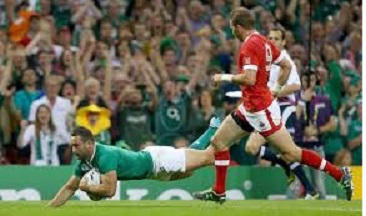
David Kearney's debut World Cup try capped an impressive, if expected, opening round victory over Canada.

David Kearney’s debut World Cup try capped an impressive, if expected, opening round victory over Canada.

Outside of and before the beautiful insanity of the endgame in Brighton, Ireland set the ball rolling with a thoroughly efficient, injury-free performance over Canada. Having put the result beyond doubt during a riotous ten minutes against fourteen men, Joe Schmidt sagely removed the ‘Unbreakables’- insofar as if they get broken we’re screwed- of Sexton and Murray with more than a quarter of the game remaining. The obvious fillips from the game, aside from the half-backs increased sharpness, were the performances of Luke Fitzgerald, Keith Earls and the increasingly influential Iain Henderson. The former pair seem as though they have the ability to wreak tandem havoc on opposition defences, while the Ulsterman is impressively living up to and indeed surpassing the weighty pre-tournament expectations  extolled upon him by the Irish public.

Ireland will probably retain only two or three starters from last weekend for Sunday’s upcoming clash with Romania. The value of developing a squad –from a competitive and not lip-service point of view- will be on display on Sunday and assistant coach Les Kiss has indicated that most if not all of the thirty one man squad will have taken to the field after just two weekends of action. In this regard the coaching team will have fulfilled some obvious but vital requirements, ensuring competition is maintained in the squad while most importantly engendering a sense of unity within the group. Of course, there is nothing to suggest that spirit and togetherness are an issue with this squad but like Banquo’s ghost, the 2007 disaster still looms large in the Irish memory.

So with one weekend down, the quite expectation remains and any lingering pre-tournament nerves should have subsided somewhat. While Japan have the chance to do something ludicrously, insanely impressive today Ireland will quietly be looking to make their statement to the world some weeks from now.

Standard
Rugby

Rugby World Cup 2015 – Group D Preview

Irl v Fr

And so to the pivotal group –from where Irish people are standing at least- where Paul O’ Connell’s side will take their place alongside Canada, Romania, Italy and traditional nemesis France. Our traditional trepidation is setting in which in small doses is a good thing but there is genuine cause for optimism this time around. The draw allows Ireland to progress gradually, hopefully step it up against Italy and then hit something close to peak form for the crucial French game.

While no Rugby World Cup will ever grab the hearts and minds of the nation quite like its soccer equivalent, there is a prevailing feeling that this is the most eagerly anticipated rugby tournament, from a national perspective, ever. Whatever happens, we’ll be playing well into October and if Joe Schmidt’s side do ultimately meet their demise it won’t be for wont of preparation or application or, say, a schism in the squad.

How fitting it would be if Paul O’ Connell’s international send-off was as a World Cup winner in Twickenham on 31st October. Sport, though, while always beguiling doesn’t often do fairy tale endings and Ireland will need everything to go right if they are to get their hands on the William Webb Ellis trophy. Still, exciting to envisage it all the same.

First to our main group rivals, France. Rumour has it that France’s is a happy camp of late and Philippe Saint-Andre’s side has been in World Cup mode for months now. But so has everybody else and they are still only a team. And a pretty mad one at that.

France

Is Freddie Michalak the right man to steer the French to victory?

Is Freddie Michalak the right man to steer the French to victory?

When the draw for Group D was made two years’ ago no Irish fan could hide their delight at the sight of France as the number one seed in our group. Australia, South Africa and New Zealand had been avoided and with French rugby is turmoil, actual and not perceived, the prevailing feeling was that while Ireland would grow under the astute guidance of Joe Schmidt, France would continue on their hapless downward spiral under Philippe Saint Andre and a favourable quarter-final against Argentina would be well within Ireland’s reach. Ireland have improved almost beyond recognition –especially considering some notable absentees who we will try our very best not to mention again- while France have continued to confound and frustrate, offering the type of fare that flies in the face of the cavalier, free-spirited French rugby of old.

And yet, on the eve of the 2015 Rugby World Cup a certain disquiet has crept into Irish hearts and minds. Haven’t they annihilated Ireland in our three previous World Cup meetings? And don’t they just turn up at these tournaments boots tossed languidly over their shoulders and do whatever the fuck they want? Lose to Tonga in the group stages? Pas probleme! We’ll just make it all the way to the final and proceed to be screwed out of a maiden World Cup victory by a referee petrified –somewhat understandably- of never making it out of the country let alone being allowed back in!

Ok, we’re being a tad reactionary and more than a little flippant but the realisation has long since dawned that the application of logic and reason based analysis –which, of course, applies in the case of the other nineteen teams at this World Cup- to French rugby is a largely unedifying pursuit. Were any other team to come into this World Cup on the back of two such disappointing international seasons, expectations would be rock-bottom –except in 2007 when we all thought it’d be grand– yet the French have an unsettling capacity to, and there is no other way to describe it, pull out the big performance on the day. Perhaps scrum-half Morgan Parra’s succinct explanation best explains the phenomenon which surrounds Les Bleus, ‘the problem is, we’re French.’ That problem, of course, works both ways.

The two recent performances against England offered up the idea that France were going to bludgeon all-comers, suffocate the life out of their opposition and maintain scoreboard control with a steady flow of kickable penalties. Not a bad thesis statement if you’ve got the ready-made components. And, from one to eight France have just this, their pack illuminated by the endlessly talented Louis Picamoles. Unfortunately for the French things get a little unusual after this. First of all, it’s worth noting that coach Philippe Saint-Andre was, in his playing days, an emblem of everything exuberant, stylish and lethally effective about French rugby. However, in a real head-scratcher and with no little talent at his disposal, Saint-Andre has decided to discard with the spontaneous yet crucially incisive back play so beloved of his countrymen.

It really is hard to understand why players like Wesley Fofana, Yoann Huget and even underrated full-back Scott Spedding do not get the opportunity to think their way into the gaps, as the French of old once did. In any event, Saint Andre has gone for brute force domination but his grand plan may well fall on the decision to entrust the keys of the juggernaut to the one-time golden boy of French rugby, Frederic Michalak. With obvious competition –or a replacement depending on which way you see it- Francois Trinh Duc bizarrely left at home by Saint-Andre, Michalak, who could very easily be mistaken for the chocolate in a ninety-nine, only has competition from the lightly tried Remi Tales. In a World Cup. Indeed, curiouser and curiouser it gets.

So France have a monster pack, an underrated defence –that wonderful aberration in Twickenham in March aside- and some really dangerous backs who must feel betrayed by this slavish devotion to the prototypical modern playing style. To be fair, size matters more than anything in the modern game, so the longing for diminutive, jinky wingers is really only a whimsical notion these days. Toulon, so dominant in recent seasons have relied on out-muscling their opposition before going for the jugular. France may not have the same personnel as the European champions but, when the time comes we suspect they’ll be ready. A titanic battle awaits in Cardiff on October 11th –on what could yet be a truly momentous day for Irish sport- as the prize at stake is a likely shot at the All Blacks, and these sides may well face each other once more. Ultimately, however much of the French odyssey this autumn will rely on a baffling coach’s decision to choose a less than trustworthy field general.

Prediction:  Quarter-finals

Player to Watch: The otherworldly Louis Picamoles. Skills of a back allied with gargantuan strength.

Italy

Italy will desperately want to prove wrong their pre-tournament doubters.

Italy will desperately want to prove wrong their pre-tournament doubters.

The prognosis is not good for the Azzurri. Shorn of attacking talent and overly reliant on an aging pack, still led masterfully by the indefatigable Sergio Parisse –who disastrously misses the opener against France- the Italians look to be well out of their depth alongside northern hemisphere compatriots Ireland and France.

It is only two and a half years –the death knell of Declan Kidney’s reign over Ireland- since the Italians completely overran Ireland in Rome, suggesting their arrival as a perennially competitive side in the Six Nations. Since, however, Jacques Brunel’s side have made little progress, having registered just one victory throughout the last two European winters, or springs if you’re completely deluded.

The pre-World Cup matches are perhaps more misleading than anything but the manner of Italy’s defeat in Murrayfield in August exposed too many gaping cracks. France come first on Sunday but this may actually be no bad thing. The French are slow starters –they lost to Argentina on the opening night in 2007 although we weren’t to know at that point that the Pumas would go to finish third in the tournament- and Italy will assuredly come out with the intention of unsettling their opponents. The problem now however is that France are purpose-built for war so this is Italy’s best weapon neutralised. In any event the loss of their totem may simply be too much to overcome.

Their other decisive game of course comes on 4th October in the soon to be home of West Ham United, Olympic Stadium in east London. And, even after taking caution into account it is very difficult seeing the Italians being victorious in this one either. The Italians will ultimately finish third in this group, comfortably, but it will only be after the outcomes –and the nature of the performances- against their main group rivals that they will be able to surmise whether or not the last four years have seen any tangible improvements.

Prediction: Third in the group.

Player to Watch: As ever, the redoubtable Sergio Parisse.

Romania

The Oaks are appearing in an eighth successive Rugby World Cup.

The Oaks are appearing in an eighth successive Rugby World Cup.

Unquestionably the most established side in Europe outside of the Six Nations participants. Romania has a rich rugby history and shares the distinction with eleven other sides of having appeared in every World Cup thus far. If Italy’s wheels completely fall off –not that bizarre when you consider Ireland’s undeserved victory over Georgia in 2007- then the Romanians may target a coup but the likelihood is that they will be battling it out with the Canadians for fourth spot. Legendary backrower Ovidiu Tonita will take the field for his fourth World Cup – he was also in the pre-tournament squad in 1999- and we’d be surprised if a hardier soul takes to the field in the next six weeks.

Prediction: Fourth in Group D.

Player to Watch: Ovidiu Tonita. A player whose quality has always stood out, even against the top-tier nations.

Canada

Quarter-finalists in 1991, Canada will need a miracle to repeat such a feat.

Quarter-finalists in 1991, Canada will need a miracle to repeat such a feat.

With the top two places in this group virtually sewn up, Canada like the Romanians, will really fancy themselves to take more than a cut out of Italy. Canadian pride recently took the worst sort of hit a Canuck can take as they suffered defeat at the hands of their southern neighbours, the USA. Canada would have always fancied themselves the boss in that neck in the woods, so they will be coming out the gap with a bit of fire in their bellies when they face Ireland on Saturday in Cardiff. Captain Jamie Cudmore –who will go toe-to-toe with old sparring partner Paul O’ Connell at the weekend- is the definitive, grizzled campaigner and his cohorts up front will have fashioned their game in the image of their leader.

The pack will scrap manfully but the quality quite simply is not there. Wing DTH van der Merwe will be familiar to Pro 12 followers but the likelihood is that he and the rest of the Canadian back line will be living off scraps for the next month.

Prediction: Fifth in Group D

Player to Watch: Phil McKenzie. Impressive Sale Sharks wing who will look to make the most of any turnover ball that comes his way.

Ireland

Expectations are justifiably, if nervously, high in Ireland.

Expectations are justifiably, if nervously, high in Ireland.

Optimism just does not sit well with the Irish as a nation. Since November 2013, right up until about six weeks ago everything was looking rosy in the newly rejuvenated Irish rugby patch. In the spring we were happy to predict –a bit dreamily to be fair- a world where Paul O’ Connell would lift the William Webb Ellis, having beaten New Zealand of course for the first time in history, with Joe Schmidt granted the freedom of every last square inch of this island. But then, as it often the case, the event horizon grew near and all of a sudden that old gnawing feeling set in: sure we’re Ireland and we don’t win things. Whether we like to admit it or not we have a perverse addiction to getting immediately high on our success and then with the comedown in full flow, morosely predicting our downfall. And then, when it happens, proclaiming fatalistically and with shameful self-knowing that you knew we’d implode at some point.

Rugby, it has to be said, has dealt some cruel blows to Ireland -assuredly we are not the only ones to have been railroaded by misfortune but unsurprisingly we only have pity on ourselves- with Michael Lynagh’s late try in 1991 World Cup semi-final in the old bear-pit on Lansdowne Road unquestionably the stand out World Cup moment of misery.

But at some point this self-doubting, pessimistic safety blanket had to be removed. Joe Schmidt has brought a calm sense of confidence and belief to Irish rugby history and convinced the players –it should be taken as a prerequisite that this is an excellent collective of players- that if they do everything he directs, as close to perfectly as possible, then they can beat anybody on any day. New Zealand was of course proof of Schmidt’s exceptional ability to rally these players, not as before for sixty minutes, but for eighty-three minutes and just a few heart-breaking seconds. While the All Blacks may find it equal parts amusing and flattering to see how a nation could get excited by a defeat the reality is Ireland had cornered New Zealand that day like on no other occasion ever before.

Successive Six Nations victories mean the winning mentality –not our natural preserve- has been effectively fostered and the squad must now for the first time ever be entering a World Cup comfortable with the idea that people are expecting them to hang around until the long evenings come in. In addition, and unlike, say Wales, Ireland have been relatively lucky with the health of their squad and the return –hopefully in the form of some good minutes on Saturday- of Cian Healy is a huge fillip.

The fifteen selected for Ireland’s tournament opener looks for now to be the nominal starting fifteen. Only a brave or mad man could have anticipated Keith Earls or David Kearney filling the wing positions when the Six Nations came to an end but like the seemingly irrepressible Iain Henderson, their form has been rewarded. These selections are not a rebuke to the likes of Simon Zebo and Devin Toner but more an indicator of the fact that at all times places are up for grabs.

We couldn’t talk about Ireland’s chances without mulling over the back line conundrum. As Gordon D’Arcy has already pointed out in his excellent weekly articles, Joe Schmidt values holding possession of the ball over anything else. The directive seems clear: only offload if you know, not think, that the ball is going to a teammates hand. D’Arcy also interestingly pointed to the fact that Schmidt would have the side practice a move maybe only ten times at something like eighty percent efficiency and then entrust the players with the responsibility to effect the move when the game time situation required it. With a flat pre-tournament in the bag let’s hope this is exactly what Ireland have in store for the group decider against France.

The greater worry at the moment is that Ireland were lacking their crisp ball movement and set-piece efficiency in the warm up games. Deep, lateral balkline movement harking back to a less exciting time gave plenty of food for thought but assuredly Ireland have been working on precision –not to mention the puzzlingly sloppy defence- in the past fortnight. Also, Conor Murray and Johnny Sexton will hope to quickly re-establish what is one of the premier half-back pairings in world rugby.

Canada and Romania will be despatched in the next fortnight but everyone knows the serious stuff –with all due respect to Ireland’s first two opponents- will begin in the Olympic Stadium at the start of October. Nobody is saying that we will definitely win this tournament or that we will even make the decider but for the first time, perhaps ever in Rugby World Cup history, this Irish team –and by extension the Irish people- can realistically look to the tournament with justifiable designs on going all the way to the final weekend.

Prediction: Semi-finals

Player to Watch: Jarred Payne. Cast in at the deep end to replace he who shall be named. Really growing into the position and could be the spark in attack.

Odds: Ireland 9/1

France 14/1

Italy 500/1

Canada 2000/1

Romania 5000/1

Standard
Rugby

Rugby World Cup 2015 – Group A Preview

Now, while we hoped for what would be a week-long preview of the twenty teams’ prospects in the upcoming Rugby World Cup fate has intervened to ensure that the following, dear reader, will be an abridged version of what we first offered. Time is a cruel mistress and devoid of well….time we’ve had to make a few amendments to our earlier plans.

Over the next two days we will bring a preview of Group A –by far and away the most compelling – and, of course the most pivotal Group as far as Irish interest is concerned, Group D. The quickest way from A to D as everybody knows is straight through B and C so we’re taking this approach quite literally. In summary, South Africa top Group B with Scotland joining them –though only just, after a gruelling battle with Samoa- in the quarter-finals. In a shocking departure from conventional wisdom, New Zealand will cruise through Group C with the Argentinians joining them in the last eight.

Throughout the World Cup, we will provide regular ‘state of the tournament’ updates while highlighting some of the more interesting talking points. And of course, given the natural progression of the tournament there will be plenty to come on the reigning champions, New Zealand and the, massively under the radar, South Africans.

Before we go anywhere however let’s just temper home expectations. Of the home nations Ireland are still the only side yet to appear in a World Cup semi-final, so getting that far alone would be a fantastic achievement, even if the obvious endgame is to become the last team standing in west London.

We’ll tackle Group A today, the so-called ‘Group of Death’ –every international tournament is obliged to have one- where hosts England, have been pooled with double champions Australia, co-hosts Wales, the mystifying Fijians and inevitable whipping-boys Uruguay. There has been considerable talk, pre-World Cup, of teams pushing themselves through the absolute limit in terms fitness and one fully believes this. This group promises to be the most attritional and when the dust settles in four weeks, the qualifiers may have too many wounds to lick. Only time, luck and squad depth will tell.

Despite what people might say to the contrary –pressure, undue expectation- home advantage in a major sporting tournament possesses immeasurable advantages; partisan crowds, unintentionally ‘helpful’ referees, familiarity and we believe an inherent pride of place. In seven Rugby World Cups thus far only one side –and a really atrocious Welsh one at that in 1999- has failed to reach at least the last four. New Zealand twice –see ‘helpful referee’ in 2011- and South Africa have been victorious while England and Australia in 1991 and 2003 respectively came agonisingly close to success in front of their home crowds. With that in mind don’t be unduly surprised by what follows below.

England

England

So, first to England who naturally as both the hosts and, well…. being England will go into the tournament surrounded by extraordinary expectation and equipped with the admirable, though often inexplicable self-confidence, which accompanies English sides. Stuart Lancaster has worked tirelessly over the last four years to win back the hearts and minds of the English rugby community following the debacle of Martin Johnson’s poorly conceived, ill-fated reign. Quite clearly the hosting of the showpiece has been at the centre of Lancaster’s thoughts –despite any laughable protestations about building for 2019- since 2011. Though nowhere close to the relentless juggernaut of Clive Woodward’s 2003 World Cup winning side, the current iteration of the English rugby team will, in our view, go mighty close to winning the tournament.

England’s strength’s –powerful pack, excellent outside threat- have been well documented so it would be remiss to avoid what may well be a glaring weakness at out-half. Now, George Ford, the incumbent ten is an outstandingly talented player, possessed of an extremely rounded skill set and will probably establish himself over the next decade as one of the world’s premier out halves. But -and this is a big but- Ford’s heretofore unconfirmed pre-eminence in the game will mean nothing for the next six weeks. The extraordinary Jonny Wilkinson is the youngest out-half at twenty-four to ever guide his side to victory in a World Cup final –doing so of course in 2003- and even then Wilkinson was five and a half years into his international career. When Ford –or indeed Fijian Ben Volovola- kick off this year’s tournament on Friday night the Englishman will be just twenty-two and with a mere thirteen caps to his name. You might be able to win Premier League titles with kids but for England to win the World Cup on home soil they will need heretofore unprecedentedly mature performances from George Ford.

That said, Ford will shine for much of the tournament, England are a well-drilled unit under Lancaster and their home sod has returned in recent times to a sort of ‘Fortress Twickenham Lite’. If England can negotiate their group –so much the less compelling for the dreadfully unlucky Leigh Halfpenny’s absence- then our gut feeling is that they might ride on a crest of a wave of quickly growing confidence and jingoistic pride –think WWII imagery- all the way to the Halloween final. This side will go close but fall just short of the heroics of the 2003 collective of sporting MBEs, OBEs and knights.

Prediction: Runner-up

One to Watch: Jonathan Joseph. A player with the near-unique ability to make inside or outside breaks. A constant threat in attack.

Folau

Australia

Former Leinster coach Michael Cheika was given a pretty interesting job around this time last year. Take an Australian team wildly low on confidence –yes you read that correctly- in complete disarray and transform them into World Cup contenders in just twelve months. From where we’re standing right now it seems like a case of job well done. A relatively successful November tour was followed by a first Rugby Championship since 2011 –also incidentally in its shortened version in a World Cup year- and Cheika now leads a side laced with cohesion, variety and most importantly a re-instilled winning mentality. Australian sport is laced with an equal parts enviable and loathsome complete, unshatterable sense that their merely being Australian makes them superior to their opponent.

Cheika is by all accounts a ‘take no shit’ coach which given their perilous state after last summer is exactly what the Wallabies required. The swagger is back but so too more importantly is the discipline demanded of an Australian side. With a small playing base, Australia has always relied on versatile, dynamic footballers allied with extraordinarily innovative coaching. The combination this year is no different, but Cheika is still faced with a headache as to who to select in the half-backs. Past performance would perhaps suggest the selections of Will Genia and Quade Cooper, but World Cups are rarely won with a conductor like Cooper. Not all the out halves who have won World Cups have been outstanding players, but they’ve all known how to play the right rugby at the right time.

While the number ten jumper may remain an issue for Australia the man at the back won’t. While all the cool kids are mentioning Kiwi Nehe Milner-Skudder as the man to watch during this tournament, our must-see player is the outlandishly talented Israel Folau. While he hasn’t played quite to his own monstrously high standards of late Folau has a skill-set that allows him perform feats –sometimes even on debut– that other players simply cannot even consider.

Australia, as the joint most successful Rugby World Cup performers of all time,- the All Blacks being the other- simply cannot be ignored. But, while Michael Cheika has worked Gordon Bombay-like wonders to rebuild the house in under a year, an appearance in the decider, though not impossible, seems unlikely.

Prediction: Semi-finals.

One to Watch: May have played our hand early here but definitely Israel Folau.

Wales

Wales

Every four years the World Cup comes around and with it the evil winds of injury. No team is safe from this nefarious non-entity but in each four-year cycle one side gets punished particularly badly, perhaps for no other reason than the cruel whims of the Fates. Already in a historically difficult group –thanks perhaps to Warren Gatland’s belligerent indifference when the group seedings took place- Wales have seen two starters go down. The loss of scrum-half Rhys Webb has been compounded mercilessly by the news that Leigh Halfpenny, one of the world’s finest full-backs, has been ruled out with an ill-timed and devastating knee injury. We haven’t been to Wales in the last fortnight but one can only imagine a borderline funereal atmosphere –and we do not mean this in a hyperbolic sense- in the country when news of the full-back’s setback was announced. Between his metronomic boot, unfailing solidity at the back and well-timed incisions into the offensive line, Halfpenny could readily be described as Wales’ most important player.

One player –with all due respect to Webb who also misses out on all rugby players’ dream of representing their nation on the global stage- does not a team make but certain players are worth far more to their side than the one-fifteenth fraction they make up on paper. One can only imagine the pervading sense of gloom in Wales but Warren Gatland is as stoic as they come –except when whinging about the predictability of Joe Schmidt’s side- and the Sam Warburton led squad will have accepted by now that the hellish Group A needs to be negotiated without Halfpenny. It would be delightful to see Wales rail against the odds and escape this group and the feeling was that pre-injuries they were on track to do something massive in the next four weeks in particular. All three big guns in this group need their top players available. Wales are now perhaps missing their best. The tournament didn’t end with Halfpenny’s injury and the talent is there but, given that Wales are now missing three of their starting backline –Jonathan Davies was lost in the summer- the hill just turned into a mountain.

Predictions: Group stages.

Player to watch: If he can somehow force his way into an overpopulated back row, the remarkable Justin Tipuric.

Fiji

Fiji

Fiji drew an unbelievably short straw when they were drawn in this group. Fijians are the most joyous rugby players to watch in full flow, seeing grass where other see bodies and possessed of blinding pace and supreme ball handling skills. As the fourth seed in say, Ireland’s group the Pacific Islanders would have a tremendous opportunity to not only take a scalp –which in any event at this stage is not enough for the Pacific Island Nations- but compete for a quarter-final spot. Only on Friday night though, in Twickenham will we know how serious a part Fiji are going to play in deciding the destiny of this World Cup.

Prediction: Group Stage

Player to Watch: Nemani Nadolo. Yes, he may seem the lazy pick but more than one winger will be made look stupid by the behemoth Canterbury Crusaders flyer.

Uruguay

Uruguay

We have not come here to patronise, but there is no point in trying to talk up the South Americans chances in this their third World Cup appearance. Full unsurprising disclosure: we don’t know a thing about this Uruguayan side but Google can tell you what we can’t. That said they are the big boys of South American rugby after Argentina and if their footballing counterparts are anything to go by, then don’t expect Uruguay to go quietly into the night.

Prediction: Group stage.

Player to watch: Augustin Ormaechea. Because this report said so.

Tournament Odds

England 9/2

Australia 8/1

Wales 25/1

Fiji 1000/1

Uruguay 5000/1

Standard
Rugby

Rugby World Cup 2015- Week 3 Preview 

 All sorts of thoughts -predominantly negative- must have gone through the heads of Irish supporters this week. Some legitimate and rational and others of the more reactionary half-baked variety. The first line of thinking which needs to be nipped in the bud is that the disastrous 2007 World Cup –which was sullied by the dreadful three-match preparation and the nadir of the shit-kicking down in Bayonne- is about to repeat itself over the next seven weeks. True, Ireland’s performances in the warm up games have been largely listless but to us they are more symptomatic of a side that is going through the motions and with good reason- Ireland need to keep the powder dry and peak in a month’s time. That said things are far from rosy in the garden –the defence which is not an area for variations and tricks up the sleeve has been decidedly porous- and it is hard to subscribe to the theory that everything will simply click into place against Italy and latterly France. Perspective does of course, as ever, need to be applied. Ireland have won two warm-up games, admittedly against largely unrecognisable Welsh and Scottish sides. A six point defeat followed against Wales, with Sean Cronin held up over the line to prevent what would have been the winning score, if perhaps undeserved. It was only at Twickenham last weekend that alarm bells –though hopefully premature- started to ring. As objective observers we can only speculate but on a balanced summary of last week’s game we have plenty of food for thought.

Ireland’s defence, or more specifically, tackling was hugely disappointing, particularly in the first forty minutes last weekend. Reliable veterans like Tommy Bowe –found wanting most obviously for Jonny May’s try- Rory Best and Devin Toner missed multiple tackles while the narrow Irish defence seemed to offer up countless opportunities out wide to the home side. Though the performance improved considerably in the second half England were well worth their eight point victory. And, though signs of life emerged, our over-reliance on a dominant tight game was heavily emphasised once more.

For Ireland to succeed next month and hopefully onwards Joe Schmidt knows that his side will have to be virtually unbreachable in defence, akin to the Six Nations winning sides of the last two seasons. On this basis the most recent defensive aberration in Twickenham is cause for genuine concern. True, England were sloppy and lacked the clinical edge which will be a prerequisite in two weeks but this is surely missing the point. Ireland should only be concerned about ensuring their defense –both in terms of systems and straight up tackling- is perfected in the next fortnight. No coach sends his side into a rugby match, of any nature, with the instruction to take it easy in defence, so as not to reveal their hand. How does the cornerstone of a very successful side, the heretofore rocksteady defence suddenly appear more flimsy than the plot of a Christopher Nolan film? We can only hope that this was the first crease ironed out in the week gone by. In any event, Schmidt and this current Irish side have enough defensive credit in the bank at this stage -though they assuredly don’t give anything remotely close to a shit about the prevailing public opinion- so for supporters it is a question of patience and trust.

The perverse nature of the Irish psyche requires us to immediately presume that the worst is going to happen when a major tournament comes around. And, let’s be fair, our rugby and soccer teams have gifted future generations with umpteen cautionary tales – humiliation in Lens, lunacy in Saipan and the perhaps never to be explained meltdown all over France in 2007- so it is an alien notion for Ireland to be approaching a global showpiece imbued with confidence.

This Irish team is entering this World Cup as a genuine contender –how genuine only time will tell- and despite our inherent naysaying this point is difficult to dispute. Too often Irish teams have played with a sense of inadequacy and perhaps fear of their opponents. Now the team play with a different type of fear, a specific fear that has been engendered during the short reign of Joe Schmidt. Now players fear losing because of the responsibility they have to their team mates and the rational, honest fear of their failings being forensically exposed by Joe Schmidt in the company of their peers.

Fear in the right form is an excellent weapon. Or as music mogul Jimmy Iovine once said, “ Fear is a powerful thing…. If you can figure out a way to wrestle that fear, to push you from behind rather than stand in front of you, that’s very powerful.” Have this Irish squad learned to tackle fear in a positive manner? Everything thus far suggests they have. But this question will not truly be answered until 11th October against France, a team who have so often
represented the fear that stands in front of Irish teams.

Standard
Rugby

Rugby World Cup 2015 Preview – Week 2

So Paul O’ Connell’s farewell to these shores was not a victorious one, with Ireland’s nemesis of recent years, Wales eking out a deserved victory in a game which admittedly went down to the final play but more of that later. Of course, the big news this week was the announcement of Ireland’s thirty-one man World Cup squad, an event that is guaranteed to cause considerable debate, though nothing close to the discourse and back and forth that the coaching team themselves would have gone through.

On selecting the squad, the only people that Joe Schmidt and his coaching team needed to answer to were the players who had been omitted. The non-selection of Andrew Trimble appeared to take up the lion’s share of debate –though honourable mention goes to Dave Kilcoyne- and the general consensus is that Ireland’s player-of-the-year in 2014 was dreadfully unlucky to miss out. Still, Schmidt’s concern -not that he needs any outsiders validation- about Trimble’s lack of international rugby, just thirty-four minutes, in the last twelve months is irrefutably valid. In any event, the squad is picked now, every selection is defensible and with our pool opener a mere fortnight away it is time to look forward. After we look backward, that is.

On reflection, our feeling is that last week’s Ireland’s performance was exactly as expected, no more and no less. As predicted here –and probably everywhere else- Joe Schmidt’s players showed little inclination to bring their three-quarter line into play and as has often been the case for Irish wingers in recent years, David Kearney and Keith Earls main tasks involved fielding and chasing kicks. Most importantly the remaining starters got some much required competitive action under their belts without sustaining any lasting injury, save for the duel scares for the historically unlucky Earls and luke Fitzgerald.

Though a forgettable game for many, highly touted New Ross prop Tadhg Furlong–adept at either side of the scrum- will remember the day forever, being both his Irish debut and the performance that earned him the last front row spot in Joe Schmidt’s squad. There always seems to be shot from the dark and this year –at least as an objective outsider- it seems that Furlong has taken this mantle. In years gone by a player like Furlong may have been deemed too inexperienced which is a ludicrously irrational line of thinking. How else does a young player gain valuable experience and indeed international playing time?

For all the grumblings earlier in the week about Wales consistently overpowering and generally dominating Ireland, it took a desperate and brilliant collective tackle on Seán Cronin to prevent an Irish victory at the death. Further to this Wales fielded virtually their entire starting fifteen  –there is no side in the world that would be weakened by Justin Tipuric’s presence- and given the gargantuan task they will face just to escape the most difficult group in Rugby World Cup history, a confidence-bolstering victory away from home was a near-vital requirement. Warren Gatland, as his custom -not unlike a heel in WWE- had a pop at Ireland’s conservatism but Joe Schmidt, whilst understandably a little prickly, left the bait well alone.

The greatest concern from Saturday –creative unknowns aside- was Wales’ and namely Justin Tipuric’s ability to dominate on the ground and relentlessly slow down the vast majority of Irish ruck ball. Which leads us to the back row selection conundrum for the final group game against France and whichever knockout game(s) is/are to follow. There has been considerable, undeniable clamour of late for the inclusion of the in-form, destructive Iain Henderson somewhere in the back five of the pack. His inclusion in the match day twenty-three must be, barring injury, beyond any possible doubt, but there are many who would like to see him start. And, with good reason on current form. If he partners Paul O’ Connell then the lineout will surely suffer for the loss of Devin Toner but it will mean Henderson –no mean lineout operator in his own right- could provide a genuine ball carrying threat in tandem with Sean O’ Brien and a hopefully fit again Cian Healy.

This, of course, is only one possible course of action. If Schmidt is inclined to stick with his usual second-row pairing then there may be a call for Henderson to replace Munster captain Peter O’ Mahony at blindside flanker. We’re big fans of O’ Mahony around here, particularly of his selfless defensive work, but his form of late has at least caused murmurs for change. But if Henderson comes in then surely Ireland will be repeating the mistakes of 2011 when everyone believed Stephen Ferris, Sean O’ Brien and Jamie Heaslip could simply smash our way to victory, forgetting of course that wars are won by mind as much as by muscle.

So to the argument for the inclusion of Henderson’s clubmate and Ireland’s best snaffler of ball on the ground, Chris Henry. A large part of why Australia beat New Zealand in the recent rugby championship decider was how their back row –which entailed a pair of nominal openside flankers in Michael Hooper and David Pocock-  absolutely decimated their opposition on the ground, providing a flow of quick ball and thus creating gaps in New Zealand’s defence around the ruck area. It turns out after years of scientific research that the All Blacks cannot beat you if they don’t have the ball. So now, Henry legitimately joins the debate as the vital component in ensuring Ireland’s ball retention while also nullifying the opposition’s attacking foundations.

Tomorrow in Twickenham sees the tried and tested combination of O’ Mahony, O’ Brien and Heaslip with only the former’s place in the tournament’s opening game realistically up for grabs. Nonetheless and based on the above we feel there is a very real possibility that Ireland’s back row will be tinkered with throughout the tournament, with a different three-man combination utilised as circumstances require. The utilisation of rotation in the very best sense of the idea.

U.S. sports allow coaches the luxury of rolling substitutions throughout the game so, for example, a basketball coach can adapt his system mid game if he wants to change from small ball to a bigger lineup. Joe Schmidt and his opposition coaches will not be afforded such assistance and perhaps because of this there is a prevailing view in both Irish and anglicised sports that you have a best starting fifteen or eleven, end of discussion.  This World Cup will ostensibly reward the best ‘team’, but for Ireland to win Joe Schmidt will – particularly considering his methodical study of each opponent- assuredly need to know when to choose the correct fifteen, and more specifically back row to meet the demands that a specific opponent poses.

Standard
Rugby, Six Nations

SIX NATIONS: ROUND 2 PREVIEW

Can the Real France Please Stand Up!

Ireland v France: 14th February 17:00 Aviva Stadium, Lansdowne Road

Philippe Saint Andre’s side arrive in Dublin this weekend without the usual whirl of excitement and unpredictability surrounding them. Last week’s victory was routine, insofar as they beat Scotland, but the Gallic flair missing in action since the turn of the decade, most certainly did not make its long awaited return. In fact the secret to success last week was a full out assault by their massive pack and the nerveless boot of outhalf experiment 257, Camille Lopez. The carefree, predictably unpredictable French really seem to be a team of the, admittedly recent, past.

That said, Ireland didn’t exactly pull up trees in Rome but a twenty three point victory away to the Azzurri should never be sniffed at. If Italy are the barroom brawler of this tournament then Ireland are the measured, risk free counter-puncher, picking you off with jabs rather than going for the lights out haymaker. Make no mistake, Ireland came out of this particular scrap, extremely comfortable victors. Joe Schmidt would have been happy with the clinical use of the numerical advantage after Italy’s Leonardo Ghiraldini was sent to the sin bin. That’s not to say that the expected accuracy was there throughout and imprecision and sluggishness were clearly evident throughout the opening hour. Whether this can be explained by the usual opening weekend rustiness and the Six Nations starting debut of five players remains to be seen.

‘Write off France at your peril ‘ was a statement that always carried weight, particularly around these parts, where a victory over France was a largely mythical concept, until Brian O’ Driscoll’s hat- trick and David Humphrey’s nerveless accuracy put paid to that, in Paris, in March 2000. That was Ireland’s first victory over France in Paris since 1975 and in that intervening period the French had been defeated in Dublin just once in 1983. After a period of minor dominance at the turn of the millennium France proceeded to register 12 out of 13 victories against Ireland in all tournaments up until the drawn game in Paris in 2012. The last three games between the sides have ended in two draws and last year’s win for Ireland, meaning for the first time since 1974 France will be looking to avoid a run of four games without a victory over the Irish. Now, I’ve used the facts to suit my argument but there is no disputing the fact that Ireland are undefeated by France in four years. A similar, once in a generation blip like this occurs between the hurlers of Kilkenny and Wexford.

As of this morning France are six point underdogs for tomorrow’s game. This could be more if half-cut, patriotic Irish fans decide to skew the market even more. I would be confident, though clearly open to contradiction, in saying that France have never in their history arrived in Dublin with the locals favoured so heavily. I have heard numerous people say this week that the bookies have this one completely wrong. My understanding, as a casual and largely unsuccessful gambler, is that the handicap line is set in response to where the public’s money is going, not because Messrs. Power and Boyle think France are rubbish and that everything Joe Schmidt touches turns to gold, although it kind of does.

My gripe here is actually with the French. How have Les Bleus, comfortably Ireland’s toughest out historically, save for their nemesis in the deep south, allowed the Irish public regard them with such disdain? Recent memories are invoked of any one of Ntamack, Dominici or Bernat-Salles cutting us to pieces with such wilful disdain and exuberance. Despite the numerous humiliating defeats one couldn’t help but hold the rogue, carefree and infinitely skilful Frenchmen in such high regard.

And how could any Irish sports fan ever forget our bête noire, Vincent Clerc, tormenting us for years and finally putting the cherry on top by stepping John Hayes in open country; if only he’d run at him beside a ruck; and silencing Croke Park on rugby’s debut in, arguably, Europe’s finest stadium.

That’s not even ten years ago and yet France’s arrival tomorrow brings less trepidation than the arrival, in a fortnight’s time, of Ireland’s whipping boys of the mid noughties, England. The French, particularly their coaching staff, should be ashamed of themselves. Just watch Serge Blanco’s winning try in the 1987 World Cup semi-final against Australia, ideally with the French commentary, then switch to last week’s horrible slog in Paris. The build up to the try is ridiculous, equal part under 8s mayhem and uncoachable, glorious, heads-up rugby. Unfortunately instinct seems to have been shorn from the 2015 edition of France.

Tomorrow’s game unsurprisingly will be won up front, admittedly a lazy statement that applies to every rugby match outside the Pacific Island Nations. Ireland’s pack is aggressive, disciplined, ferocious at the breakdown and actually slightly heavier per man than France. The French are always incredibly abrasive though and their game will surely be predicated on tight carries by the pack, supplemented by some monsters off the bench and the assistance of the bulldozing, borderline unstoppable when he’s on form, Mathieu Bastareaud.  The French backline, on paper, where everyone bar the players themselves play out these games, is every bit as impressive as Ireland’s, and considerably better in one area, midfield. Here, France have Bastareaud and Wesley Fofana, who if used correctly, are surely the greatest centre pairing in world rugby; a complimentary rugby equivalent of Laurel and Hardy. Fofana glides through defences in a manner similar to the great Conrad Smith and his strength belies his relatively narrow frame. The back of three of Yoann Huget, South African Scott Spedding and the superbly named, throwback left wing Teddy Thomas are every bit as impressive as opposite numbers Kearney, Bowe and Zebo. However the caveat with this French backline is that they can be unstoppable but only if used correctly or rearmed with their traditional licence to thrill. While solid last week, it didn’t look as though Lopez and South African scrum half Rory Kockott, see the theme here, were going to allow their outside backs rain hell on the Scots. There is no question that Ireland enjoy a clear advantage in this department, even taking into account Jonathan Sexton’s inevitable, early rustiness.

Perhaps both sides were keeping their powder dry last week but I don’t buy this theory for a second. Schmidt cuts his cloth to suit the measure while Saint Andre’s team have been rudderless and uninspired since the beginning of his stint as French head coach. If he’s playing the long game with the World Cup in October in mind, then I tip my hat to him. But let’s be honest, he isn’t.

Ireland’s back row has the potential to become a missile launch site once more with the return of the ever dependable Jamie Heaslip and Ireland’s most exciting and, when fully fit, devastating ball carrier, Sean O’ Brien. Thierry Dusautoir, Damien Chouly and Bernard le Roux, from guess where, bring plenty of ballast themselves and will be more than content to go to war. Whoever dominates at the breakdown should present decent go-forward ball to either Lopez or the returning Sexton. Ireland need to be more creative in midfield and the suspicion remains that Robbie Henshaw is playing one position too far inside. Bastareuad and Fofana will welcome traffic up the middle with glee and return it with interest.

Both back threes, as mentioned, are brimming with attacking potential and the midfield playmakers will need to employ subtlety, Bastareaud aside, to unlock two very well organised defences. Stuart Hogg had some moments of brilliance last week in Paris and the opportunity should present itself for Simon Zebo and Tommy Bowe to find some unmanned green grass, particularly once the game breaks up a little in the second half. The Cork man seems to be playing with a chip on his shoulder for Ireland and thus far it suits him. A moment of brilliance by him, Bowe or the electric Thomas may well decide this contest.

Even as an Irishman who gets giddily excited as to what may await us in the next eight months, I long for the return of the swashbuckling, give a flying shite, French team of years gone by.

Unfortunately they won’t make their return tomorrow. I don’t think we, the Irish public, are a million miles off this time.

Ireland by 6.


England –v- Italy – 14:30 – 14th February – Twickenham

A brief, lazy deferral to history to summarise this one.

On 14th February 1929, six members of Bugsy Moran’s Irish mob on Chicago’s north side were executed, the result of a long running feud with legendary, infamous Italian American mob boss, Al Capone. The incident would go down in lore as The St Valentine’s Day Massacre Tomorrow. Tomorrow in Twickenham history should repeat itself but unfortunately for the Italians, there’s little chance of them springing the surprise attack.

The weather isn’t forecast to be great for London tomorrow but frankly it’ll take a monsoon to stop this contest turning into a slaughter. The English juggernaut is most certainly up and rolling and Stuart Lancaster’s side will be well aware that, in a tight Championship where a Grand Slam looks unlikely, points difference will most likely come into play. Once the game gets loose don’t be surprised if everybody outside George Ford gets on the score sheet.

The Italians are always game, to a man, but that won’t be near enough here.

England by 35 (and the rest)

Scotland –v- Wales – 15:00 – 15th February – Murrayfield

This game is intriguing for a number of reasons. Firstly, Wales’ record, 51-3, beating of Scotland in last year’s closing round will be to the forefront of everybody’s mind, north of the Wall. However the Scottish sides of March 2014 and February 2015 are definitely not the same animals. Once aimless and toothless, Scotland’s performances in November and more so last week suggest that Vern Cotter has breadth new life into a team who had been lurking in the wilderness for far too long. The Scots, just like their opponents tomorrow, are a massively proud nation and Cotter has very adeptly tapped into this, at least from the outside looking in, latent pride.

Cotter, like his friend Joe Schmidt an alumni of Clermont Auvergne, has taken a rudderless team and instilled discipline and confidence, two cornerstones to any successful side. Tomorrow is a real litmus test as a narrow, brave defeat will no longer cut the mustard with either the players, it never does to be fair, or the Scottish public.

Wales come to Edinburgh on the back of a chastening defeat to England where they squandered an early ten point lead and failed to score in the second half. In truth the five point defeat could have been so much worse and the manner of the defeat, getting comprehensively outplayed in every facet of the game by your greatest and oldest rival at home, has to be disconcerting for Warren Gatland and his coaches and players, not to mention the wider Welsh public. Gatland ran home with his ball on Friday night and gave his players the silent treatment for letting him down. It’s tough enough for the players to deal with a defeat at home to England without being treated to Gatland’s childish histrionics. Nonetheless hooker Richard Hibbard rallied during the week and said that the “players owe him that (a better performance) for giving us a second chance.” As if he was going to drop the entire team!

It appears that Gatland’s template has become dated. To his credit, using huge men to smash smaller men has brought great success to Wales in recent years but change and variety are vital and the best coaches and teams are always evolving, even if only very slightly. This Welsh team misses Shane William’s trickery and the unfairly maligned Jamie Roberts can’t be relied on to batter down the castle gates every single time. It was intimated last week that Wales are performing with one eye on the World Cup. I prefer Clive Woodward’s blueprint in 2003; annihilate all in front of you and set down a marker for the World Cup later on that year. It’s defecate or get off the pot time for both sides on Sunday.

Finn Russell, Alex Dunbar and the mercurial Stuart Hogg should get plenty of opportunities on Sunday to usurp their more illustrious opponents. Hogg can and does match the ridiculous with the sublime but in an era of increasingly one sized giants, his potential to unlock a defence is invaluable. Scotland need to win to continue their development, Wales to dismiss the nagging feeling that theirs has ceased altogether.

As AC/DC’s Bon Scott and his inimitable voice squealed all those years ago, “It’s a Long Way to the Top if you Wanna Rock ‘n’ Roll”. Scotland aren’t even close to there yet but a victory on Sunday will confirm that their ascent continues in earnest.

Scotland by 2

Bill Lonergan – 13th February 2015

Standard